














Editor & Publisher: Rabb Majumder
House # 05 (2nd Floor, 2-C), Road# 04, Banani DOHS, Dhaka - 1206
Phone: +8801715822782
Phone (Advertisement): +8801712863234
Email: rabb.h.majumder@gmail.com, info@securityworldbd.com

Changing Dynamics of Reserve Currency Hegemony-What Shape and What Shakes
Dr. Jamaluddin Ahmed, FCA
14:05, 1 August, 2026
Part-II

Jamaluddin Ahmed FCA PhD
is a member of the Board of Directors, Emerging Credit
Rating Limited, can be contacted- jamal@emergingrating.com
Tools in the Tool Box. Individual sanctions represent an
attempt to avoid harming the adversary’s civilian population by personally
punishing key elites. These sanctions were first introduced against Haitian
military leaders in 1993 and have since grown to include visa bans, asset
freezes, and blacklisting of the affected individual (and sometimes their
family members) from conducting business with reputable financial institutions.
Financial sanctions are designed to block the target from transacting with the
financial institutions and in the financial markets of the U.S. and its
commercial partners. In practice, this severing from the dollar system can
undermine the target nation’s banking industry, currency, and ability to process
international payments. With the so-called War on Terror, the U.S. honed its
ability to apply pressure on adversaries via the international financial system
and has deployed such sanctions repeatedly against both state and non-state
actors. Secondary sanctions are used to sanction third-party economic actors
that attempt to do business with sanctioned entities.
While they are simply an enforcement mechanism for primary
sanctions and often take the form of financial sanctions on banks or
corporations that transact with a sanctioned entity, it is useful to treat them
as distinct because they must inevitably target the firms of allied or neutral
states, thus generating detrimental political consequences.
Do sanctions work, Sanctions are a frequently used tool
because the domestic politics behind them are compelling. Imposing sanctions
provides a political bump to policymakers who want to appear strong during
international disputes without incurring domestic political risk (Taehee Whang,
2011). In these cases, whether the sanction works well or not as a policy tool
is less important than its ability to be touted before domestic audiences. As
long as sanctions remain on, policymakers can argue that the target entity is
paying a price for its behavior, regardless of whether the sanction is actually
advancing the desired foreign policy objective. Scholars have extensively
examined the effectiveness of sanctions; the research shows economic sanctions
tend to be ineffective at changing state behavior, primarily because other
self-interested nations will step in to fill the void where the U.S. or its
allies have severed relations.
It’s good to be the King. The U.S. is the world’s largest
national economy, but its economic influence pales in comparison to its
dominance of the global financial system. U.S. financial dominance is
predicated on three pillars: U.S. dollar dominance makes it the world’s
foremost reserve currency; U.S. banks’ role as a clearinghouse for many global
financial transactions; and The reach of its regulatory apparatus. The USD is
the global reserve currency, meaning central banks and other financial
institutions stockpile USD to make investments and transactions or influence
exchange rate. Although there are other reserve currencies, USD accounts for
more than 60 percent of central bank currency reserves. Furthermore, roughly
half of loans worldwide are denominated in USD, and 40 percent of international
payments are processed using the dollar. Breakdown of $10.6 trillion in global
share of reserves by currency (2018) are USD (62.2%). EURO (20.4%), British
Pound (4.5%), Japanese Yen (4.9%), Canadian Dollar (1.9%), Chinese renminbi
(1.7%), Australian Dollar (1.7%), Swiss franc (0.2%) and other currency (2.5%).
The Central banks prefer holding U.S. dollars as part of their reserves because
of its widespread use, stability, and the strength of the U.S. economy.
Weaponizing Economic Interdependence. As policymakers have
realized the power financial dominance confers, they have weaponized economic
interdependence—to use the term coined by political scientists Henry Farrell
and Abraham Newman— against an increased set of targets.
Tightening the net with secondary sanctions. As the U.S. has
become more comfortable with financial sanctions, it has also taken to using
secondary sanctions to completely isolate targets even from neutral third
parties. An example is the Helms-Burton Act of 1996, which allows suits in U.S.
courts against foreign companies doing business with the Castro regime in Cuba.
The passage of the act led the Europeans and Canada to pass “blocking
statutes,” which forbid their companies from cooperation with U.S. sanctions
efforts. In September, the U.S. sanctioned the Chinese military’s weapons
development department following the purchase of Russian weapons in violation
of U.S. sanctions on Russia. More recently, the chief financial officer of
Chinese tech giant Huawei was arrested in Canada at the request of the U.S. for
allegedly helping violate sanctions on Iran, sparking a diplomatic row and the
retaliatory arrests of Canadians in China. The U.S. has followed up with
criminal charges against Huawei itself for sanctions evasion and other crimes,
a move that is a negotiating chip in a trade dispute, but also likely to
further harm U.S.-China relations.
The Challenges to US Financial Hegemony, as U.S. has
dominated the global financial system for a long time. As long as other nations
perceived U.S. power to be exercised judiciously and with a nod to their
interests, they had no incentive to pursue radical change. But as the U.S.
weaponized this system in recent years, the risk of relying on U.S. goodwill
has become evident to other nations, leading them to take steps to counter
American dominance. This manifests primarily in efforts to build alternative
infrastructure and moves to chip away at the dominance of the dollar. Russia
and China have been two of the first movers in this regard, due to their size
and role as traditional rivals of the U.S. After the first round of sanctions
forced Visa and Mastercard, two major payment processors in Russia, to cut ties
with some of their customers, Russia introduced a national payment system known
as Mir in 2014. It also developed a domestic messaging service known as SPFS
that mirror’s SWIFT’s function and others in progress. China is trying. CIPS
has come a long way since its 2015 founding. It has grown from 19 direct
participants and 176 indirect participants at its inception to 31 direct
participants and 829 indirect participants today, while also expanding service
to cover more time zones and standardizing its protocols to bring them in line
with SWIFT (Gjoza,). It has also significantly expanded both in the volume and
value of transactions it handles.
China’s payment clearing and settlement system has seen
rapid growth since its launch in 2015. Similarly, the BRI, while facilitating
increased use of RMB in some areas, has seen a decline of RMB use in others
(SWIFT, July 28, 2017). Out of the 68 BRI nations, 33 are rated below
investment grade, suggesting that they pose too much of a credit risk to secure
development loans on the open market. Decreased foreign dependence on the USD
would translate to reduced influence on these issues and decreased ability to
effectively pressure states like North Korea when it truly matters.
Economically, a fragmentation or balkanization of the international financial
infrastructure could reduce the value of the dollar and drive up the cost of
financing U.S. debt, even if the U.S. continues to lead the largest emergent system.
A shift in central bank purchases away from USD toward other currencies would
represent a significant reduction in demand and lead to a devaluation of the
dollar.
That shift could be politically destabilizing in the U.S.
Net interest payments in the 2019–2020 fiscal year amount to $479 billion,
exceeding the annual cost of Medicaid “Fiscal Year 2020, Budget of the U.S.
GovernmenTt). By 2027, even at the modest interest rate projections of 3.7
percent, the U.S. government will pay $788 billion in interest, surpassing the
projected defense budget for that year and accounting for 13 percent of federal
spending (up from roughly 9 percent in 2019; Fiscal Year 2020, Budget of the
U.S. Government). Should a loss of confidence in Treasuries spike interest rates
far above those projections, the U.S. could be paying $1 trillion annually in
interest alone. While a full-scale withdrawal from Treasuries would be costly
for major investors like China and Japan, declining foreign participation in
Treasury auctions is already happening.
How Great Powers Pursue Monetary Hegemony. A Comparison
Between the United States and China Currency Swap Policies. The political
economy literature shows that monetary hegemony guarantees significant
privileges to a country’s economy—governments gain greater flexibility in their
budgetary and current accounts without incurring significant macroeconomic
imbalances. Such greater economic policy flexibility also shapes the global
balance of power since governments have fewer fiscal constraints to enhance
their military spending. One of the main instruments governments can use to
enhance or preserve their currency’s position in the international monetary
system is establishing currency swap lines with other central banks. Yet the
policies of central banks differ, and so do their effects on currency power. It
contend that a country’s political regime explains the different constraints it
faces in its quest for monetary hegemony.
The theoretical framework to elucidate the difference
between currency swap policies in democracies and autocracies have been
discussed and proceed this in a comparative analysis of the Fed and PBOC
currency swap policies. Revel that the United States restrains access to its
currency swap lines with countries that are critical to the stability of the
global economy and that levy small credit risk to the Fed. Ultimately, the US
monetary authority fears domestic political backlash from their international
operations. In the case of China, credit risk is not a concern due to the lack
of popular scrutiny. Swap lines are extended to advanced and developing
economies as financial stability and economic development instruments. However,
China’s swap line policies cannot fully succeed since the authoritarian nature
of the government impedes the implementation of reforms necessary for a
country’s monetary rise: free capital flows and liquid capital markets.
Essentially, the economic advantages that a reserve currency status provides to
a country determine a significant part of its national security capabilities.
Since a state can enhance its economic power by dominating the monetary system,
the strength and international acceptance of a country’s currency affects its
military capabilities. Ultimately, the reduction of fiscal constraints due to
the dollar reserve currency condition facilitates the U.S. government’s ability
to have the largest defense spending in the world. For instance, Thomas Oatley
(2015) explains that financial power is the mechanism through which the U.S.
government could overcome the so-called “crowding out constraint.” Essentially,
the U.S.’s highly liquid capital markets and low credit risk conditions
continuously attract foreigners to hold dollar-denominated assets.
China also wants to achieve a higher level of monetary
dominance to experience some of the privileges that the dollar provides to the
United States. Therefore, Chinese officials are pursuing policies to
internationalize its currency. For that, China’s government is seeking to
increase the use of its currency in trade and financial transactions and raise
the renminbi’s allocation in the foreign exchange reserves compositions of
central banks. In autocracies, the constraints that the political leadership
faces are different. After all, financial openness, and economic
liberalization, which are critical elements for achieving reserve currency
status, can also represent a threat to the capability of autocrats to remain in
power. Freeman and Quinn (2012) show that financially integrated autocracies
are more likely to democratize than financially closed autocracies. This
happens because the elites in autocracies gain a greater bargaining position
over tax rates when diversifying their assets to overseas investments. As a
result, they became less worried that the rise of the democratic regime would
impose confiscatory taxes on them. However, that is not the only reason
authoritarian states do not want to give up substantial control over their
economies.
How the Fed and the PBOC Justify their Currency Swap Lines
Agreements. It seems reasonable to conclude that currency swap lines are
essentially a tool used by the Federal Reserve to fulfill the global liquidity
demand, preserve the stability of the international monetary system, and
preserve the role of the dollar as a global reserve currency in periods of
crisis. Such a perception is corroborated by the analysis of Federal Reserve’s
documents that publicize the rationale for establishing these swap lines.
Those documents emphasize the importance of currency swap lines
as an essential tool to minimize the effects of the global crisis on the U.S.
economy and maintain the stability of the international monetary system. This
temporary arrangement with the ECB is proposed to allow dollar funding problems
now faced by European banks, particularly at terms longer than overnight, to be
addressed more directly by their home central bank. Improved conditions in
European dollar trading would guard against the spillover of volatility in such
trading to New York trading and could help reduce term funding pressures in
U.S. markets. Fundamentally, the worries regarding the credit risks of currency
swaps are a genuine concern of a monetary institution in a democratic country
like the United States. After all, the Federal Reserve has a high degree of
independence to enhance the credibility of its actions. Nonetheless, their
credibility also relies on the accountability of their actions.
People’s Bank of China. The PBOC currency swap lines
converge with the Fed because such an instrument is considered an important
tool to promote global financial stability. On the other hand, the PBOC does
not demonstrate significant concern about the credit risks of such operations.
In the reports, interviews, and speeches analyzed, Chinese officials perceive
swap lines as an instrument that can enhance China’s and its economic partners’
development by facilitating bilateral trade and investments. The swap lines are
also an instrument to facilitate the development of the Belt and Road
Initiative, as well as a tool to reform the international monetary system by
emphasizing the importance of reducing the dollar monetary hegemony. 3
Essentially, currency swap lines are one of the primary tools of Chinese
economic officials to promote the internationalization of the renminbi.
Who receives currency swap lines from the Fed and the PBOC.
When a 2020 map of the Fed’s and PBOC’s bilateral currency swap arrangements is
displayed, the distinct approaches that each country is tanking for enhancing
or preserving their currencies’ status in the international monetary system
becomes evident. The countries colored in purple are the countries that have
established swap agreements with both the Fed and the PBOC. It is noteworthy
that all these central banks represent developed regions of the world and,
therefore, are critical elements for the stability of the global economy and
financial systems. Ultimately, it is not surprising that both the PBOC and the
Fed cooperate with the central banks of the Canada, Australia, New Zealand,
South Korea, Japan, Euro Zone, and Switzerland. Together, the countries under
these central banks’ jurisdictions corresponded to approximately 31% of the
global economy in 2019. Moreover, all these central banks’ currencies have
reserve status, except South Korea, Singapore, and New Zealand.
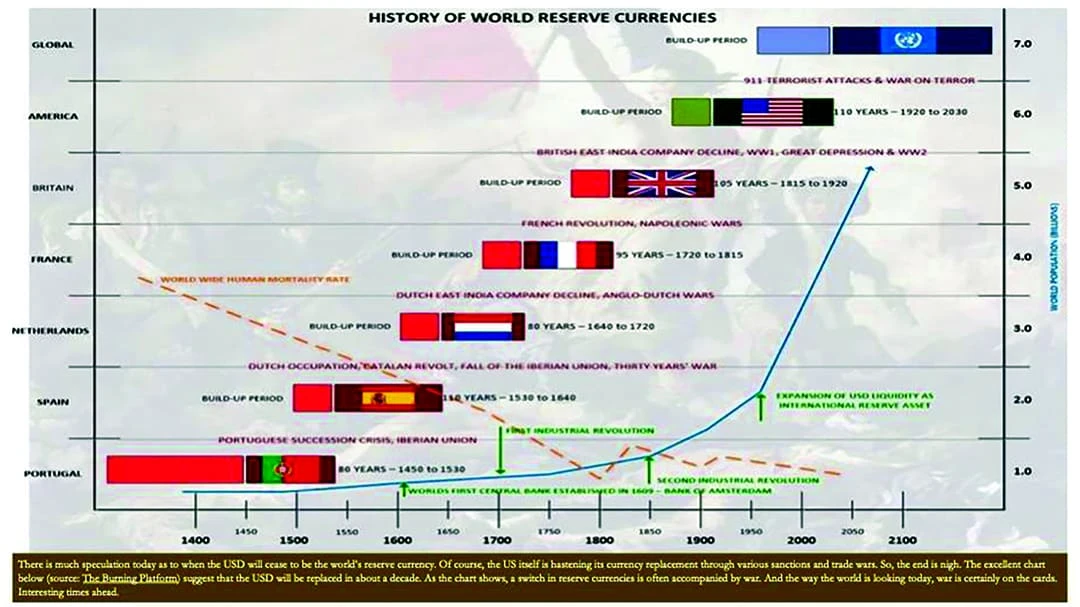
History provides evidence of reserve currency build up
period for Portugal 80 years (1450-1530), Spain 110 years (1530-1640),
Netherlands 80 years (1640-1720), France 95 years (1720-1815), Britain 105
years (1815-1920) and the USA 110 years (1920-2030 estimated).
USA ranked the as the 6th nation that took the currency
hegemony from Britain in 1920. In most cases changing currency hegemony power
were ended through war. The winner country’s currency took over from the
defeated nations and their currency took position of reserve currency. From the
economic point a single currency might be appropriate to reduce transaction
cost although the socio-political economy does not permit in reality in all
cases.
The benefits of reserve currency stressed by the economists
include transaction costs, familiar gains of international seigniorage. The
political scientists include leverage and reputation, risk of undue currency
appreciation. The exorbitant privilege enjoyed by the issuer of reserve
currency which potentially is significant distributional consequences. Cross
border use of dominant currency can loosen constraints of payments on domestic
monetary and fiscal policy which is easier for policy makers to pursue public
spending objectives and external discipline is relaxed. Between 1860-1914,
nearly 60 percent of world trade was dominated in sterling although the UK
accounted 30 percent. More recently when dollar ruled 45 percent of
international debt securities in dollar (end 2008), 86 percent of all foreign
exchange transactions (2007) 66 countries being dollar as anchor currency
(2008), for many countries 70-80 percent of trade is denominated in dollars,
and most commodities are priced in dollars and dollar still rules shadow world
of crime and illicit transactions.
Britain’s gradual loss of key currency status was
simultaneous with gradual political and military pre-eminence as noted the
quote from Harold Wilson. History provides interesting examples of the reserve
currency status by the US for achieving noneconomic and economic objectives.
The reserve currency status and cheaper financing it
afforded, may have been the rope that allowed the USA to hang itself.
PBOC cannot use the renminbi to intervene in foreign
exchange markets. The heart of the problem that China’s current growth strategy
is heavily reliant on export which is fostered by competitive, undervalued
exchange rate, a closed capital account in limiting the local currency by
foreigners and for international transactions. The prerequisite for the use of
the renminbi as international reserve currency yet to market must free first
become more transparent, banks must be commercialized, supervision and
regulations must be strengthened, monetary and fiscal policy must be sound and
stable, and exchange rate more flexible. China must first move away from a
growth model where bank lending and pegged exchange rate have been central
pillars. In short, there are many reasons to believe that China is far away
from attaining major reserve currency status. Although the rise of dollar and
its eclipsing of sterling as the primary reserve currency was quicker than
expected and it would have been even quicker had politics and history no
intervened. If a currency becomes a global unit of accounts through its use in
trade invoicing, that increases the demand to hold that currency to conduct
trade, which bolsters its position as a global store of value. Similarly, if
there is a lot of global demand to hold a currency as a store of value, that
reduces the cost of borrowing in that currency and makes it attractive for
traders in other countries to price exports in that currency to access that
cheap funding market.
In the wave of technological innovation may get priority
over economic power seems to takeover by the superiorityof the scale of
technologial development of a country inaddtion to economic and military power.
Since WWII US led SWIFT system was the main mechanism created by NATO alliance
helped USD to become doninant currency status added by many other economic
factors added to issuing sanction to competitions. The USA late joining WW1
extended loan the British encouraging joining the war and overthrew Pound
Sterling and took leadership of World Reserve Currency Leadership without a War
in the absence of any technological and economic and business competition from
others. The unipolar system of Dollar hegemon continued since 1920s and
stregthened more after the WWII and demise of Gold Standard in 1971 by the
President Nixon.
With the rise of China in trade and investment since 1971
and later the fall of Soviet led communism these countries merged capitalist
financial management with command economy and running an efficient economic
management. Many country developed their own wire system like SWIFT and making
transaction beyond US led SWIFT system. In face of sanctions and currency war
affected countries has developed their mechanism like swap and other unknown
techiniques and proving to be surviving. This signals a challenge to USD hegemony.
China achieved the technology superiiority in the payment system and Central
Bank Digital Currency already. Scholars in this field, are predictiong that
once China have open democracy, independent central bank, independent
judiciary, develop financial system and prove to be the safe heaven investment,
it can challenge the USD hegemony (Easwar S Prashad, 2014) in his book, The
Dollar Trap). Meantime, the victim countries can take their arrangement through
currency swap arragement which the USA also practicing with their hostile
countries like China. Otherwise, war cannot be avoided among Challengers.
Bangladesh should also, as short term, initiate currency swap attempts for
their imports and exports related transactions.
Most economists agree that it has its benefits, though not
many would say they qualify as exorbitant. The law of supply and demand implies
that higher global demand for dollar-denominated Treasuries means the United
States can attract buyers at lower interest rates, allowing it to borrow more
cheaply. But in practice, this advantage appears slight.
One of the recent sanctions that garnered a lot of attention
was the decision to bar several Russian banks from SWIFT. Many commentators
referred to this as the financial “nuclear option,” since it effectively cut
those banks off from much of the global financial system. Because many of the
transfers that use SWIFT are made in dollars, some feared this action could
spark a negative backlash against the dollar. Some economists to speculate that
we could be heading toward a “multipolar” world of many different competing
currencies, which could have some advantages.
Many economists point to a new kind of Triffin dilemma as a
greater risk to dollar supremacy than the use of sanctions. Just as the United
States faced a crisis of confidence in its ability to back the dollars in
circulation during the Bretton Woods era, economists have warned that it could
face a similar challenge in the coming years to supply enough safe assets to
meet global demand while simultaneously maintaining confidence in its ability
to repay its debts.
Drivers of Reserve Currencies include four key elements in
determining reserve currency status, The economic size/dominance of reserve
issuers, credibility of reserve issuers, Inertia, and reserve currency shares
at the global level. Trade Links as a factor could lead to more diversified
supply chains and/or localized production to avoid overreliance on a single
dominant supplier country in the future, with implications for the demand for
reserves. For instance, more localized production could reduce international
trade and subsequently the demand for international reserves.
Recalibrating sanctions policy to preserve U.S. financial
hegemony: The American economy, dollar, and banking system create unparalleled
power for the U.S. in the global financial system. This power provides
disproportionate influence over the world’s key economic and financial
institutions, regulatory authority over major foreign companies and banks, and allows
borrowing on favorable terms and in dollars, enabling long-term deficit
spending.
Do sanctions work. Sanctions are a frequently used tool
because the domestic politics behind them are compelling. Imposing sanctions
provides a political bump to policymakers who want to appear strong during
international disputes without incurring domestic political risk (Taehee Whang,
2011). It’s good to be the King. The U.S. is the world’s largest national
economy, but its economic influence pales in comparison to its dominance of the
global financial system.
Although there are other reserve currencies, USD accounts
for more than 60 percent of central bank currency reserves. Furthermore,
roughly half of loans worldwide are denominated in USD, and 40 percent of
international payments are processed using the dollar. Breakdown of $10.6
trillion in global share of reserves by currency (2018) are USD (62.2%). EURO
(20.4%), British Pound (4.5%), Japanese Yen (4.9%), Canadian Dollar (1.9%),
Chinese renminbi (1.7%), Australian Dollar (1.7%), Swiss franc (0.2%) and other
currency (2.5%). The Central banks prefer holding U.S. dollars as part of their
reserves because of its widespread use, stability, and the strength of the U.S.
economy.
Weaponizing Economic Interdependence. As policymakers have
realized the power financial dominance confers, they have weaponized economic
interdependence—to use the term coined by political scientists Henry Farrell
and Abraham Newman—against an increased set of targets.
In the wave of technological innovation may get priority
over economic power seems to takeover by the superiorityof the scale of
technologial development of a country inaddtion to economic and military power.
Since WWII US led SWIFT system was the main mechanism created by NATO alliance
helped USD to become doninant currency status added by many other economic
factors added to issuing sanction to competitions. The USA late joining WW1
extended loan the British encouraging joining the war and overthrew Pound
Sterling and took leadership of World Reserve Currency Leadersip without a War
in the absence of any technological and economic and business competition from
others. The unipolar system of Dollar hegemon continued since 1920s and
stregthened more after the WWII and demise of Gold Standard in 1971 by the
President Nixon.
With the rise of China in trade and investment since 1971
and later the fall of Soviet led communism these countries merged capitalist
financial management with command economy and running an efficient economic
management. Many country developed their own wire system like SWIFT and making
transaction beyond US led SWIFT system. In face of sanctions and currency war
affected countries has developed their mechanism like swap and other unknown
techiniques and proving to be surviving. This signals a challenge to USD
hegemony. China achieved the technology superiiority in the payment system and
Central Bank Digital Currency already. Scholars in this field, are predictiong
that once China have open democracy, independent central bank, independent
judiciary, develop financial system and prove to be the safe heaven investment,
it can challenge the USD hegemony (Easwar S Prashad, 2014) in his book, The
Dollar Trap). Meantime, the victim countries can take their arrangement through
currency swap arragement which the USA also practicing with their hostile
countries like China. Otherwise, war cannot be avoided among Challengers.
Bangladesh should also, as short term, initiate currency swap attempts for
their imports and exports related transactions.
আরও পড়ুন -