










Editor & Publisher: Rabb Majumder
House # 05 (2nd Floor, 2-C), Road# 04, Banani DOHS, Dhaka - 1206
Phone: +8801715822782
Phone (Advertisement): +8801712863234
Email: rabb.h.majumder@gmail.com, info@securityworldbd.com

NATIONAL INTEREST IN THE AGE OF SPACE SCIENCE
Air Vice Marshal MAHMUD HUSSAIN (Retd.)
14:29, 1 August, 2026
Air Vice Marshal Mahmud Hussain (Retd)
Served as the Bangladesh High Commissioner to Brunei Darussalam from November 2016 to September 2020. He was also Chairman, Civil Aviation Authority of Bangladesh (CAAB). Currently, he is working as Distinguished Expert at Aviation and Aerospace University, Bangladesh (AAUB).

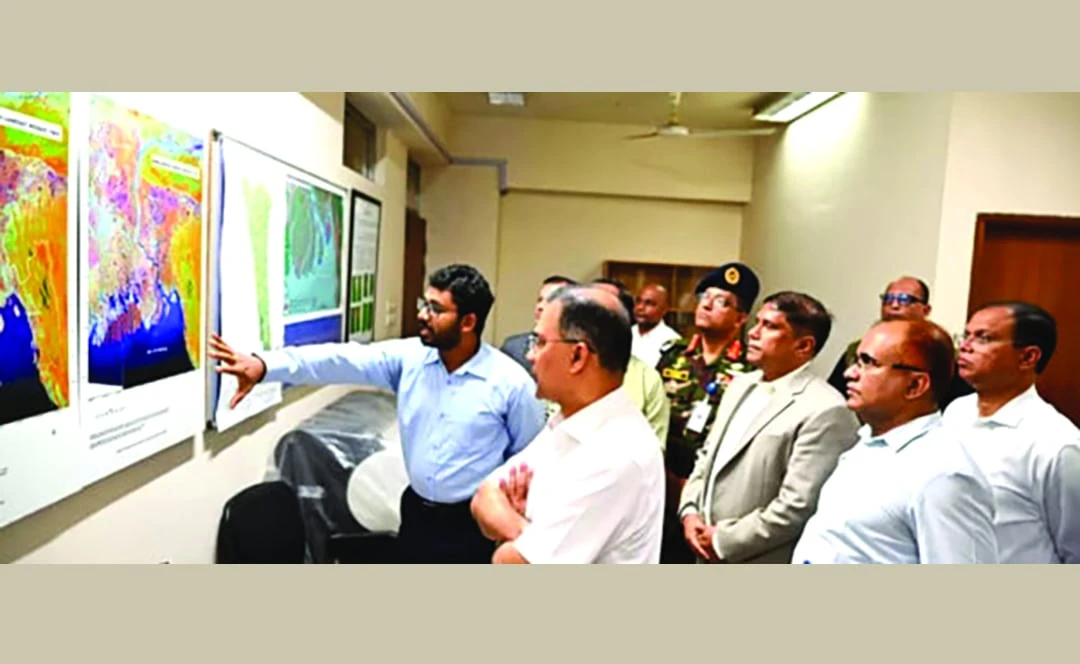
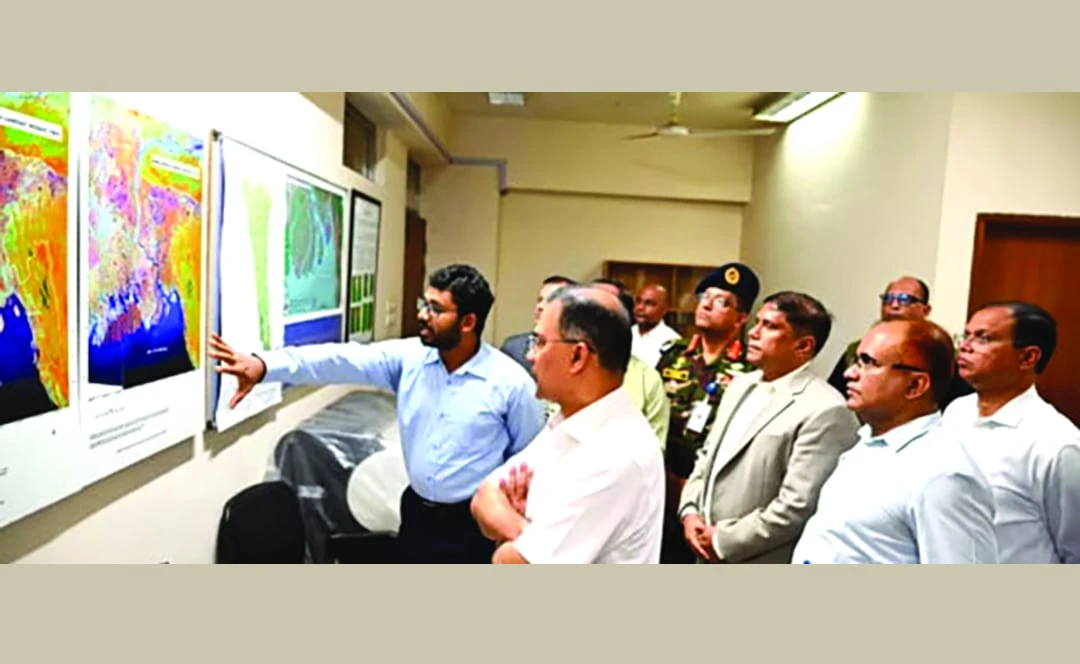
On 26 June 2026, the Prime Minister Tareque Rahman paid an unofficial visit to Space Research and Remote Sensing Organization, whose acronym is SPARRSO. It was a sudden visit not included in the official list of Prime Minister’s schedule. This is probably the first time that a Prime Minister has taken a government office by surprise just to personally witness the state of its professional standards. The visit also carried a message of promise to a nation, and a conviction to integrity something which is so much in short supply in the performance barometer of our bureaucratic discipline. The only time when the officials take their sincerity to rectitude reflecting professional binding is during annual inspections.
Such an unplanned visit by the Prime Minister suggests that it meant a very significant intent of his motivation. On the other hand, institutions and those who are involved with space science activities, the visit was highly inspiring and an ambitious illumination in the direction of their work. He instructed the members of SPARRSO to work hard to turn it into a modern, futuristic and self-reliant space research entity. He encouraged them to take initiatives and take meaningful steps to mold it into a model of academic excellence and practical source of knowledge exploration. Knowledge will lead to searching for ever-advancing core of epistemological wisdom, and practical acumen to gaining grounds into building tools, machines, gadgets and infra-structures from the best of scientific minds. Such a prolific engagement of the talented people cannot be over-exaggerated for national security and economic development. The role of Space Science in such national commitment cannot be ignored, and its advancement has to be continuous, and coextensive with international protocol.
SPARRSO, as an institution, is a pride for us. Notwithstanding, there is a lot of ground to cover in research, and embodiment of knowledge into meaningful pragmatic output is what requires sincere attention from the policy-makers.
SPARRSO came into being in 1980. In real perspective, the institution was founded in Dhaka of the erstwhile East Pakistan in the premises of the Atomic Energy Centre. At the beginning, its role was very limited, and its principal job was to surveil and interpret weather from satellite pictures. In 1975, SPARRSO started the valuable task of making maps showing areas of natural resources in Bangladesh. In 1980, the organization was given an autonomous status and put under the jurisdiction of Defence Ministry. This was probably done considering the sensitivity and richness of geo-strategic topography of Bangladesh. Maps, of course, provide rich knowledge to an adversary of the communication links that facilitate the movement of troops during war. In 1971, one of the reasons that Pakistan army suffered huge losses was due to the hostile mapping features of Bangladesh entailed in its geography which could only be negotiated by a native of this riverine land.
In 1991 through Act 29, SPARRSO was reorganized to frame the path of national space policy. Of its many responsibilities, the salient ones were to predict storms and floods, and ascertain the condition of the farmlands from the satellite pictures. It took help from world’s renown space agencies, such as NASA and of Japan, to augment its activities. Thus, it began its international partnership in collecting satellite imagery with the outside world. But the most noticeable part of such initiative was that the peaceful use of Space Science was augmented through collaborative work. Even then there is no hesitation in saying that the present state of SPARRSO leaves much to be said about not making full use of its potential.
In the realm of national security and development, SPARRSO’s role is not much recognizable. Therefore, it can be easily surmised that the Prime Minister’s visit must have enthused entities and personnel, both military and civilian, who use multi-faceted aspects of space resources in their business.
SPARRSO, Bangladesh Tele-Communication Limited Company (BTCL), Grameen Phone, Bangla Link and Bangladesh Military are among the foremost organizations which have to depend on space knowledge, and information gathered from satellites. Besides, there are other establishments also who use satellite services for data connectivity and digital information gathering.
On 12 May 2018, Bangladesh launched its first satellite from US Kennedy Space Centre. Bangladesh used Elon Musk’s Space X Company’s launch vehicle to steer its satellite into space. The main function of this satellite is to use bandwidth for tele-broadcast, internet service, data provision, disaster management and regional leasing agreement. It is worth noting that Bangladesh Navy uses the satellite for domestic maritime security for protection from non-traditional threats.
So far, I have discussed about the use of Space Science in one-sided affair. While referring to Space Science, we only focus our attention to governmental and non-governmental organizations. We never look at the source where the seeds of its germination are hidden. It is the academia. If we want to join the race in the competitive world of “Space Realization” and convert its efficacy into an outcome-based national power, we have to tun our focus on academia. Space is essentially a knowledge-based domain, and the precincts of that domain are embedded in the cognitive biases of brilliant intellect, but our policy makers hardly do grasp that truth. Educational institutions have a role to play in firing the hopes of ordinary public to aspire for higher purposes in learning. It was in 2017 that a nano-satellite named Onnesha built by the students of BRAC university was launched into the international space station. The satellite is not operational now, but it paved the way for inspiration among young generation. The satellite also marks the talent and ingenuity of Bangladeshi students that if given opportunity, they will be no lesser than the best of the world.
In modern times, the value of Space Science is limitless. Since when the West unfettered the shackles of Space Science from the authority of geo-politics and military competition, from then this branch of knowledge has opened up its doors to its varied manifestations of civilian utility. Though the purpose of Elon Musk’s Space X is commercialization of space, it is through this venture that the excellence of Space Science has spread to the niche of young talents. As a result, we see that attraction to Space Science is germinated from very early childhood in the United States. The present market value of Space X’s assets stands at 1.8 billion US$. The conclusion is that Space Science does not only have scientific and technological value but it also has a commercial value which can offer startling contribution to the dimension of economic progress.
In our neighboring country India, space exploration and activities have started in civilian hands. The national space research institution of India is named Indian Space Research Organization (ISRO). The commercial arm of this state entity is called NewSpace India Limited (NSIL). By virtue of India’s Space Policy -2023, it has officially allowed civilian organizations to build and launch commercial-purposed satellite into orbit. This has enabled India to sprout, just under three years, civilian space organizations like Skyroot Aerospace, Pixxel, AgniKul Cosmos, Dhruva Space and Bellatrix Aerospace. These are the front ranking start-ups. They have ushered in a new era of scientific thinking in space domain.
Bangladesh has the above examples by way of formulating its national space policy. First of all, we have to remember that Space Science belongs to the high end of knowledge spectrum. This will require students who are brilliant and possess incessant faculty for deep research to be nurtured by the state. At the state level, modern academic planning is needed to produce talented scholars. In this scheme must be infused a life-long learning passion of the academicians. At present, the acronym STEEM (Science, Technology, Engineering, English, Mathematics) has become a cliché word in the academic world. Space Science is a very specialized oeuvre, and its educational excellence depends on staying at pace with the latest scientific innovations. If we do not start its base from the school level, it will be difficult to produce talented youth at higher levels of education.
Aviation and Aerospace University, Bangladesh, in short AAUB, is the only specialized university of its kind to impart theoretical and practical education in Space Science. Its graduate and post-graduate level course curricula are set as per the international standard.
Despite being just six years old, its qualitative edge has enabled the students under the leadership of first-rate faculty to participate in international competition in China and the United States where they have earned noteworthy appreciation for their creative and splendid work. Their productive power and creative intellect has displayed their originality in designing and building UAV, Rover and proto-type of nano-satellite which put behind the ingenuity of the students from advanced countries. This proves that given state-level inspiration, funding and employment opportunity, there is no doubt that Bangladesh’s space domain holds a very promising future. If this piece of truth is not taken seriously, then the brilliant young talents of the country will migrate to the West in search of thirst for knowledge. This will only profit the most advanced economies in exchange of Bangladesh’s most valuable human resource. The wherewithal for attracting brilliant youth are stored in the West. So, the merit of a government depends on its ability to harness the potential academicians, both students and teachers, with means available within the country. That requires a national strategy of pulling resources with an achievable action plan but also the soft means of revitalizing the spirit of nationalism.
SPARRSO, BTCL and Bangladesh Air Force (BAF) should give access to the students for research and collaborate works. Let me give a concrete example. If Bangladesh wants to build its own indigenous satellite, it can form a dedicated group of researchers with top faculty and students for a period of five years. With the help of BAF, BTCL and SPARRSO, AAUB members should work closely as a unified team. These five years, if need be more, they should be given high salary, so that they do not have to look for jobs elsewhere or fly abroad for better opportunities. But if need be, government should send them abroad for acquiring higher skills in training and research. It is only if the government takes such bold steps that Bangladesh will one day produce its own satellite with its own resources and its own talents.
At last, we have to realize that the Prime Minister’s visit to SPARRSO has kindled the spark into the hearts of our young generation for dreaming the higher altitudes of scientific knowledge. In fulfilling that dream, the concerned agencies must accept the domain of Space Science as a challenge. To do so, the trinity of academia, industry and policy strategists should evolve into an eco-system, and must start work immediately before it is too late. In that tryst with group dynamics, the faculty-scholars and the brainy-students should be in the lead.
আরও পড়ুন -