Editor & Publisher: Rabb Majumder
House # 05 (2nd Floor, 2-C), Road# 04, Banani DOHS, Dhaka - 1206
Phone: +8801715822782
Phone (Advertisement): +8801712863234
Email: rabb.h.majumder@gmail.com, info@securityworldbd.com

Rise of the Pivotal Power
MJ Akbar
02:26, 14 October, 2026
author of, among several titles, Tinderbox: The Past and Future of Pakistan. His latest book is Gandhi: A Life in Three Campaigns.

The BRICS summit underlined Modi’s skills as a bridge builder and
reinforced India’s credibility in creating space for peace between binaries
hardened by wars and suspicion
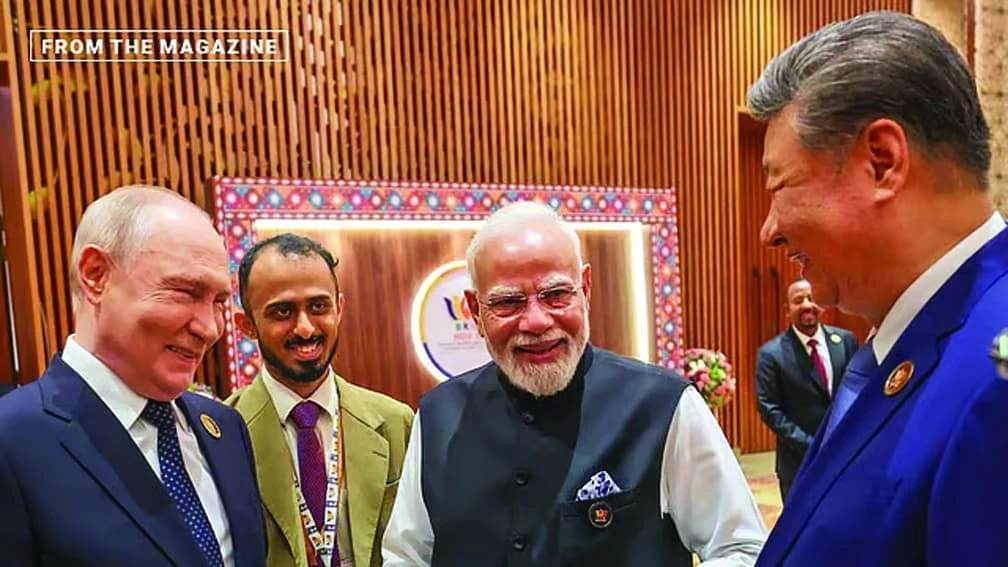
Two pictures and a phrase were the dictionary and thesaurus of the
18th BRICS summit of 11 member states on its 20th anniversary.
When China’s inscrutable President Xi Jinping becomes scrutable,
it is because serious thought has been put into the shift. His normal visage at
the highest point of visual camaraderie is at best a manicured smile. On
Saturday, September 12, his eyes lit up, his face beamed with genuine pleasure,
and a wide smile broadened into a laugh as he joined the laughter of Prime
Minister Narendra Modi and President Vladimir Putin at the BRICS conference
hall in Delhi. In a telling display of warmth, Modi gripped Xi’s arm with one
hand and clasped Putin by the other. All three knew that each gesture, each
move, each word was an international message through the world’s cameras.
Images of this triangle of laughter within a circle of bonhomie went viral and
made the front pages of every relevant newspaper on Sunday morning.
If a picture is worth a thousand words, then the laugh was worth a
million for analysts in chanceries and the dark rooms of deep-state departments
in every important capital.
The body language of the second photograph, in which Modi took
Iran’s President Masoud Pezeshkian by the hand and walked with him to a high
table upturned the existing calculus of Indian policy towards the conflicted
lands between the Arabian and Mediterranean Seas, underlined Modi’s skills as a
bridge builder, and reinforced India’s ascent as a benevolent power with the
credibility to create space for peace between binaries hardened by war.
It was a conscious rather than impromptu gesture, indicating the
rapport that Modi and Pezeshkian had established during their first meeting at
Bishkek less than a fortnight earlier. Public vibes and closed-door discussions
lifted India-Iran relations from mists of uncertainty to clarity. The mature
goodwill bore fruit at BRICS; it will influence the strategic dynamics of the
coming years.
The phrase which entered the lexicon, “politico-diplomacy”, was written into the text of the Delhi Declaration to ensure a life longer than conference semantics. With deft politico-diplomacy, Modi asserted the principles of his policy, even as he worked behind the scenes for a pragmatic, practical route map towards a new security and stability architecture.

Leaders of the BRICS member states at the summit, New Delhi, September 13, 2026 Credits: Getty Images
There was no disagreement from any country as India included
comprehensive condemnation of terrorism as criminal regardless of motivation,
“in all its forms and manifestations, including the cross-border movement of
terrorists”, and cited the specific example of the Pahalgam attack on April 22,
2025.
Prime Minister Modi established India as a pivotal power in the
vast and volatile region between Europe and the Indian Ocean, a mature voice
when the cacophony of war is accompanied by atonal discord, economic coercion
and the monster threat of an iniquitous, disruptive, aggressive and even
genocidal AI technology.
Politico-diplomacy is driven by leaders with vision. It implies
that conversations between tailored suits and silken ties are not enough.
Modi’s politico-diplomatic leadership persuaded UAE’s Sheikh Khaled Mohammed
bin Zayed Al Nahyan to meet Pezeshkian to resolve differences over the Delhi
Declaration in the best way: one-to-one. Their faces were stoic, but they found
a way. This could be a precursor for a larger role for India’s prime minister
as American power ebbs from West Asia and chameleon ideas like the Mecca Pact
slither to an early demise.
Riyadh discovered the limitations of cheque-book security when the
Mecca Pact crumbled upon the first impact. Pakistan and Turkey became invisible
as the Houthis took coastal islands and cities over Bab al-Mandab and thereby
effective control of the most active supply line of Saudi energy through the
Red Sea. Pakistan’s generals, who in August were foaming with triumphalism,
became as quiet as has-beens. Pakistan fled from a commitment sealed with a
prayer before the holiest mosque in Islam and lubricated by a financial bailout
of another $3 billion. The payback was betrayal. One welcome outcome is that
talking about an Islamic NATO has faded.
Pakistan’s impotence was compounded by US President Donald Trump’s
flat rejection of the Saudi distress call. Curiously, Trump explained that the
Houthis had told him not to enter this war. No one knew that he had a hotline
to the Houthis. Churchill said that war was God’s way of teaching Americans
geography; it seems the Trump White House has just received an overdue
geography lesson.
The Gulf’s perennial storms can shut any window of opportunity
with a sudden gust. It requires strength to keep that window open. West Asia
needs healing, a new normal. A new world order will remain a cliché without
serious repair of the old.
In the last six months, West Asia’s dynamics have changed but core
problems have not. Iran was vulnerable at the start of the war. Saudi Arabia
and the Gulf are vulnerable now. Hamas has survived an unprecedented assault,
and Hezbollah remains a fighting force. Israel is in upheaval, although its
military strength can never be underestimated.
The crisis is an opportunity to address the fundamental issue of
Palestine, seriously and not whimsically. The Palestine paragraphs in the Delhi
Declaration are remarkably unambiguous. Israel was not mentioned, but no code
is required to decipher the BRICS rejection of “forced displacement of
Palestinians from Gaza Strip” and prolonged occupation; affirmation of “the inalienable
rights of the Palestinian people” and “full membership” of the UN as a
“sovereign, independent and viable State of Palestine within the
internationally recognized 1967 borders, which included the Gaza Strip and the
West Bank, with East Jerusalem as its capital, in order to achieve the vision
of two States living side by side, in peace and security”. BRICS also opposed
any attempt to alter the legal and historical status of “occupied Jerusalem”.
India’s prime minister made it very clear that BRICS would be
relevant only if it changed from a talk shop to a workshop, if it became a
rule-maker instead of a rule-taker. He did not cover any weakness in diplomatic
wool.
The summit took a firm stand on the disruption in the world economy created by the wishlist of a superpower, although the US was not mentioned. “Unilateral sanctions”, “secondary sanctions” and “coercive measures” were inconsistent with WTO rules. Modi, Xi and Putin reminded BRICS that unity was strength. Together they constitute 40 per cent of the world’s GDP, 50 per cent of its population and perhaps 100 per cent of common sense. As Modi pointed out, the GDP of BRICS countries has grown by 4.5 times since 2006; the rest of the world grew by 2.5 per cent. There was categorical rejection of some signature decisions of Trump, including the targeted bombing of Iran’s nuclear facilities which are already under IAEA watch.

Iranian President Masoud Pezeshkian meets Abu Dhabi Crown Prince Sheikh Khaled bin Mohamed bin Zayed Al Nahyan, September 12, 2026 Credits: Getty Images
BRICS is also a consolidation of the new might of Asia. Asia was
present in force: China, India, Russia (three-fourths of which is in Asia),
Iran, Indonesia, the Philippines, Egypt, Saudi, the UAE. They ignored Trump’s
threat to impose a 10 per cent tariff on any country aligning with
“anti-American policies of BRICS” and opted for “fast, low-cost, more
accessible, efficient, transparent and safe” intra-BRICS trade on mutually
beneficial terms. On September 11, India and Russia signed a pact that includes
rupee-rouble payments and $50 billion worth of investments. Much of this
investment is likely to be in defence. Putin looked relaxed and very much at
home in Delhi.
Xi, who will chair BRICS in 2027, recognised that cooperation
between India and China was key to its future. He had a very practical message:
leave as much of the past behind so that it does not become an obstacle to the
future. India and China, he added, were not rivals. Both countries promised to
remain sensitive to each other’s core concerns.
Xi’s opening remarks included a warning: “Challenges unseen in a
century are accelerating across the world.” One of the unseens has become one
of the unknowns.
China, eager to outpace America in high technology, is apprehensive about manoeuvres by the high-tech companies who control the world market. The Frankensteins who created the AI monster are busy in a strange campaign against themselves. Dario Amodei of Anthropic says the AI industry lied to the people in its pursuit of wealth and wants to give control to the “right combination of governments”, with Sam Altman of OpenAI and Elon Musk of just about everything joining this enthusiastic peal of alarm bells. The “right combination” excludes China. Beijing believes that this remarkable outbreak of honesty from capitalism’s premier wealth-squeezers is a ploy to stop China’s ascendancy, which would destroy their business model. It is an expensive model. This year alone $2.5 trillion is being spent on AI. China stressed BRICS cooperation in open-source access, digital currency and training young engineers and scientists. Xi and Modi were both wary about the weaponisation of high technology.

Modi and Indonesian President Prabowo Subianto at the summit, September 13, 2026
BRICS has no reason to be and is not hostile to America. India
seeks the best of relations with Washington. Putin meets Americans who come
with suggestions for the end of the Ukraine war. Xi is preparing for a visit to
America. In Delhi, BRICS members indicated that they had not become sovereign
states to dilute their independence.
There has been near-unanimity about the success of the Delhi
summit. Turkey has voiced interest in membership. The lobby in Dhaka which
stopped Prime Minister Tarique Rahman from participating seems to be suffering
from non-buyers’ remorse. It has used a strange alibi: Delhi’s invitation was
to Bangladesh rather than the prime minister. The format for such invitations
is the same for every guest.
BRICS, said Modi, has come of age. Perhaps the time has come for
India and China to think about the use of a cliché, the Global South. The term
began as a replacement for the Third World. It was an attempt to suggest that
the Global North, or Europe, ravaged the Global South through colonisation. But
colonisation was also racist, with implications that the Global White was
inherently superior to the multicoloured Global Palette. We may need a positive
term that promotes the idea of the kind of national resurrection that India and
China have shown.
BRICS, said President Xi, has embarked on its Golden Decade. He
said this in Delhi because the Golden Decade began in Delhi.
আরও পড়ুন -