



Editor & Publisher: Rabb Majumder
House # 05 (2nd Floor, 2-C), Road# 04, Banani DOHS, Dhaka - 1206
Phone: +8801715822782
Phone (Advertisement): +8801712863234
Email: rabb.h.majumder@gmail.com, info@securityworldbd.com

Beyond Hardware: Building National Military Capability and Strategic Resilience
Md Mostafizur Rahman, ndc, hdmc, afwc, psc, PhD
13:05, 16 October, 2026
Military capability is not simply purchased; it is built through national aspiration, sustained investment, professional institutions, technological adaptation and the capacity to endure strategic uncertainty.
The author is now working as a Professor (Adjunct) in Military Institute of Science and Technology

A strong military is often judged by the hardware it possesses—fighter aircraft, warships, tanks, artillery, air-defence systems, missiles, helicopters, surveillance platforms and increasingly sophisticated information technologies. Hardware is undoubtedly necessary. No contemporary military can remain operationally credible while indefinitely relying on obsolete technology.
Yet hardware alone does not constitute military capability.
A modern military is developed over decades through the selection of people, professional education, training, doctrine, leadership, logistics, maintenance, technological adaptation and institutional culture. Equipment becomes meaningful only when a country possesses the human and institutional capacity to operate, maintain, sustain and eventually replace it.
This distinction becomes particularly important when societies debate defence expenditure, military accidents and modernisation. Every state confronts the enduring dilemma popularly described as “Guns versus Butter”: how much of its finite national resources should be devoted to defence and how much to competing priorities such as education, healthcare, infrastructure and economic development? The question, therefore, is not simply whether a country should spend more or less on defence. It is:
What level of military capability does the nation aspire to maintain, what strategic purposes should that capability serve, and what national resources and institutions are required to sustain it?
That is ultimately a question of national strategy.
The Military as a National Institution
A military is different from an ordinary occupational organisation. In a professional military, officers and soldiers are selected through deliberate processes assessing education, physical fitness, character, psychological suitability, leadership potential and professional competence. They then undergo demanding training before assuming responsibilities involving national security.
A military officer or soldier does not enter the profession through hereditary entitlement. He or she accepts an obligation that may ultimately require the sacrifice of life in the lawful service of the state. That creates a distinctive relationship between the individual, the military institution and the nation.
The nation asks its military personnel to remain prepared during peace so that they can respond when the country faces its most serious security challenge. A military may spend decades preparing for a war that, fortunately, never occurs. Yet the absence of war does not eliminate the requirement for readiness.

Readiness has a cost. Training, maintenance, ammunition, fuel, spare parts, infrastructure, communications, medical support, professional education, exercises and technological renewal all require sustained investment. Much of this expenditure does not produce an immediate commercial return. Its value lies in preparedness, deterrence and the capacity to protect national interests when required. The military should therefore be understood as a long-term national capability, not merely as another government expenditure programme.
Beyond Hardware: Technology Is Necessary but Not Sufficient
There is sometimes a tendency to construct a false choice between people and technology. A professional military requires both. Modern warfare increasingly depends on precision weapons, surveillance, electronic warfare, cyber capabilities, unmanned systems, advanced communications, air defence, artificial intelligence and sophisticated platforms. A military that refuses to modernise its equipment risks losing operational relevance. Thus, acquiring newer technology is not inherently excessive. In many circumstances, it is indispensable. But sophisticated equipment does not automatically produce sophisticated capability. A modern combat aircraft requires trained pilots, competent engineers, maintenance infrastructure, spare parts, appropriate weapons, realistic training and safety procedures. A modern naval platform requires trained crews, dockyard facilities, technical support, fuel, ammunition and maintenance systems. Technology creates potential.
People, institutions and training convert potential into capability.
This is why military modernisation should not be reduced to procurement. The real test of modernisation is whether the country can absorb, operate, maintain, sustain, upgrade and eventually replace the technology it acquires. The objective should therefore be neither “hardware at any cost” nor “people instead of hardware”. It should be balanced and sustainable military capability.
Guns versus Butter: A National Choice
Every government confronts competing national priorities. A developing country must invest in schools, universities, hospitals, roads, energy, employment, social safety nets and technological development. At the same time, it cannot ignore defence and national security.
This is the enduring Guns-versus-Butter dilemma. Defence expenditure has an opportunity cost. Resources allocated to defence cannot simultaneously be spent on another priority. But inadequate defence capability can also impose substantial costs when a state is unable to protect its territory, sovereignty, maritime interests, airspace, population or strategic infrastructure.
The answer cannot therefore be reduced to the proposition that more defence automatically means less development, or that development makes defence unnecessary. The appropriate balance depends upon national circumstances, strategic environment, economic capacity, threat perception and national aspirations. Most importantly, the military alone cannot make that choice.
Military professionals can assess threats, identify capability gaps, advise on force structures and explain the consequences of different levels of readiness. But they cannot determine the country’s overall allocation of resources. That is a matter for the constitutional and political authorities. The military’s responsibility is to provide professional and candid military advice. Political leadership’s responsibility is to determine national priorities and make the corresponding resource choices. This distinction is fundamental to a healthy civil–military relationship.
Classical civil–military scholarship, particularly Samuel Huntington’s concept of objective civilian control, similarly emphasises professional military expertise under legitimate civilian authority. For Bangladesh, this relationship also has a constitutional foundation: Article 61 vests supreme command of the defence services in the President, while Article 62 provides for parliamentary regulation concerning the defence services. The constitutional framework therefore establishes political authority alongside professional military responsibility. The objective should be neither military autonomy nor bureaucratic substitution for military professionalism, but an institutional division of responsibility.
The Human Cost of Readiness
The discussion of military capability should ultimately return to the individual military personnel. Officers and soldiers enter service fit and are trained to maintain high physical standards. Yet military service places unusual demands on the human body and mind. Repeated physical exertion, load carriage, field conditions, sleep disruption, operational stress, injury and exposure to traumatic events can have consequences that extend well beyond a particular training exercise or deployment. International evidence demonstrates substantial burdens of musculoskeletal and psychological conditions among serving personnel and veterans. A systematic review has found chronic non-cancer pain to be common among military veterans, while studies of serving personnel identify musculoskeletal conditions among major sources of medical limitation. Mental-health conditions, including post-traumatic stress disorder and other common mental disorders, are also documented among military populations.
These figures should not be interpreted to mean that military service inevitably causes illness. Military personnel are also exposed to many of the same health risks as the wider population. The broader point is different:
The human beings who generate military capability are themselves a national strategic resource.
If the nation asks its soldiers to remain prepared for the most demanding circumstances, it also has a responsibility to provide appropriate training, equipment, medical support, rehabilitation, safety arrangements and, where necessary, long-term care. The soldier is not merely an instrument of national defence. The health and welfare of those who bear the burden of readiness are part of national military capability.
Military Accidents: Risk, Responsibility and Learning
Military training is inherently demanding. Live firing, aviation, parachuting, diving, armoured manoeuvres, mountain operations and explosives handling involve risks that cannot be completely eliminated without eliminating the training itself. This does not mean that casualties should be accepted as inevitable. It means that some residual risk exists in preparing people for inherently dangerous activities.
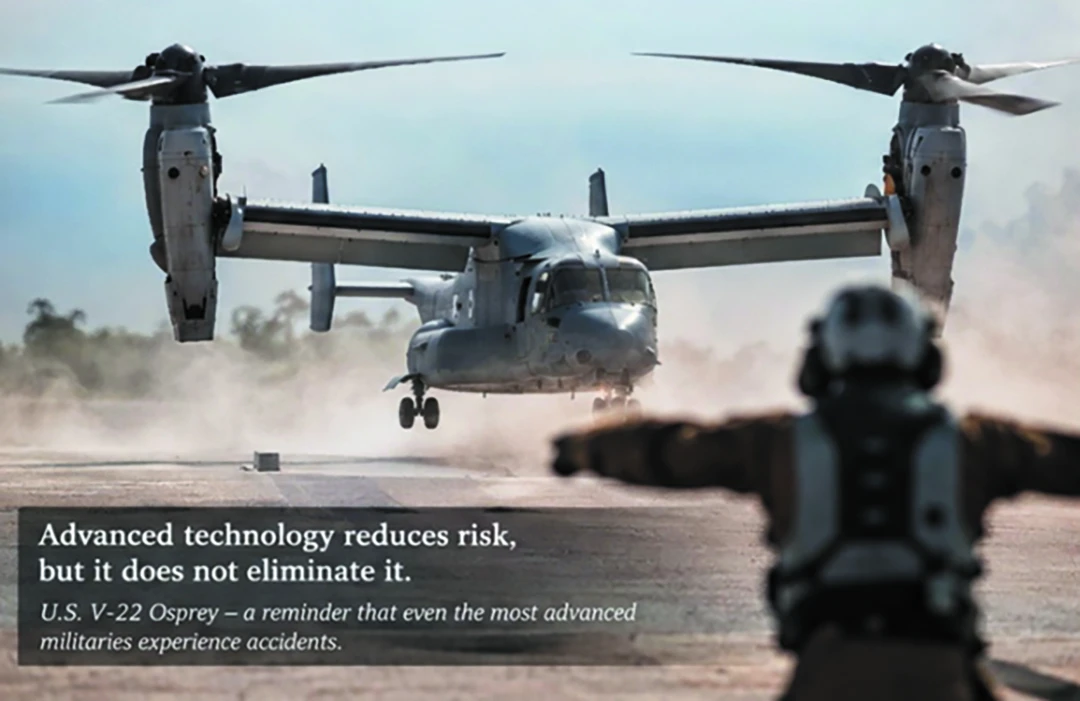
Importantly, highly advanced militaries also experience serious accidents. The U.S. V-22 Osprey provides a contemporary example. Despite being an advanced military aircraft, U.S. Government Accountability Office analysis identified 18 serious non-combat Osprey accidents during fiscal years 2023 and 2024, involving death, permanent disability, extensive hospitalisation, major property damage or aircraft destruction. GAO found that reported causes included human error during operations and maintenance, as well as materiel failures involving airframe and engine components; environmental factors were also identified. The lesson is not that advanced technology is ineffective. It is that technology changes the character of risk; it does not abolish risk.
A modern platform can still be affected by mechanical failure, human error, maintenance problems, environmental conditions and organisational weaknesses. The same principle applies to other military activities. Some accidents may result from unforeseeable technical failures or environmental circumstances. Others may reveal inadequate maintenance, defective equipment, insufficient training, poor supervision or procedural violations. These categories must not be treated as identical. Therefore, after a serious military accident, the appropriate response should be neither automatic blame nor automatic exoneration. It should be professional investigation. The essential questions are:
What happened?
Why did it happen?
What factors contributed?
Were those factors foreseeable?
Were reasonable preventive measures available?
Was the equipment fit for purpose?
What should change?
Accountability is an essential part of this process. Where negligence or willful violation of safety procedures is established, appropriate accountability should follow. But accountability should not create a culture of fear in which personnel become reluctant to report hazards. The objective is fair accountability combined with institutional learning. Not every accident is preventable. But every serious accident can be investigated, and every investigation should seek lessons.
Strategic Endurance: What Iran Teaches—and Does Not Teach
Military capability must also be judged by the ability to sustain it when normal conditions change. The opening phase of a conflict and the ability to sustain a prolonged conflict are different military problems. A country may possess sophisticated weapons on the first day of a conflict. But if it cannot replenish ammunition, repair damaged equipment, replace critical components, maintain communications or secure external supplies, its initial capability may gradually decline. Iran’s experience provides a useful contemporary case for examining this question. Iran does not possess the overall conventional military or technological resources of the United States. Nor should its capabilities be presented as equivalent to those of leading advanced militaries.
Yet Iran has spent decades developing selected indigenous capabilities while operating under sanctions, export restrictions and significant external technological constraints. Its missile and unmanned systems programmes demonstrate an emphasis on developing capabilities that can be produced, adapted and regenerated domestically. The relevant lesson is not that Iran has overcome technological superiority. It has not.
Nor should Bangladesh attempt to replicate Iran’s military strategy, which emerges from a very different geopolitical, economic and security environment. The lesson is narrower and more useful:
A country’s ability to regenerate selected military capabilities under external constraints can contribute significantly to strategic endurance.
This is particularly relevant to countries that cannot guarantee uninterrupted access to external defence supply chains.

Bangladesh: Geography, Wartime Accessibility and Selective Indigenisation
Bangladesh must examine this issue through the realities of its own geography. The country occupies the northern part of the Bay of Bengal and lies at the intersection of South and Southeast Asia. Its geography creates important economic and strategic opportunities, but it also means that the assumptions of peacetime logistics cannot automatically be carried into a major regional crisis.
Conflict could disrupt shipping, aviation, insurance, financial transactions, port operations, energy supplies and international logistics. A supplier might remain politically willing to assist but become physically unable to deliver. A component available in the international market today could become inaccessible tomorrow. This leads to an important distinction:
Peacetime availability is not the same as wartime accessibility.
This does not mean Bangladesh should seek complete military self-sufficiency. Such an objective would be economically unrealistic and technologically unnecessary. The more practical objective is selective strategic self-reliance. Indigenisation should not simply mean manufacturing a weapon domestically. It should mean progressively increasing national control over those elements of military capability that become critical when external access is constrained.
The first priority should be maintenance and repair capability. Bangladesh should progressively develop the ability to inspect, maintain, repair and overhaul major systems domestically wherever technically and economically feasible. The second is sustainment—ensuring reliable access to selected spare parts, ammunition, consumables and other critical items. The third is selected technological capability. Bangladesh does not need to manufacture everything. It should identify areas where its industrial, engineering, academic and technological base offers realistic possibilities. The fourth, and perhaps most important, is knowledge.
A country that merely assembles imported components without developing the engineering knowledge necessary to understand, modify, integrate and maintain them remains dependent. Indigenisation is therefore ultimately about knowledge as much as production. Bangladesh’s own defence-industry scholarship has recognised that complete self-reliance is impractical but that selected areas of self-reliance can be developed progressively. This suggests a pragmatic approach combining international procurement with domestic capability development. A useful framework is therefore:
Buy where necessary. Build where feasible. Collaborate where beneficial.
Major acquisitions should consequently be evaluated not merely by asking, “What platform are we buying?” but also: “What national capability are we acquiring with it?” Can it be maintained domestically? Can selected components eventually be produced locally? Can national engineers participate in integration and modification? What technical knowledge will remain in the country? What happens if external technical assistance becomes unavailable?
These questions transform procurement from a transaction into a component of national capability development.
A 30–90–180-Day Planning Question
One useful way of thinking about strategic resilience is to ask:
If external military supply were seriously disrupted tomorrow, what essential capabilities could Bangladesh continue to operate after 30, 90 and 180 days?
This is not a prediction of war. It is a planning question. The answer could reveal vulnerabilities in ammunition, fuel, spare parts, maintenance, communications, technical expertise, transportation and industrial production. It could also identify where indigenous capability would have the greatest strategic value.
This does not require Bangladesh to maintain an unnecessarily expensive wartime economy during peace. It requires identifying the critical capabilities whose loss would disproportionately reduce national defence capacity. This is where strategic reserves, repair capability, technical personnel, alternative suppliers and selected domestic production become important. The objective is not autarky. It is resilience. Peacetime efficiency often encourages lean inventories and globally sourced supply chains. Wartime resilience requires some redundancy, alternative sources, repair capacity and strategic reserves. A sensible national defence policy must therefore balance both.
Building Rather Than Buying Capability
A strong military is not created simply by purchasing advanced weapons. Nor is it created simply by increasing defence expenditure. It is built through a sustained national process involving political purpose, professional military expertise, appropriate resources, human capital, technology, training, maintenance, logistics, doctrine, safety, research and institutional learning.
Modern hardware remains indispensable. But hardware is only the beginning. A fighter aircraft becomes meaningful capability when the country can train its pilots, maintain the aircraft, sustain its weapons, repair its systems and continue operating it under difficult conditions. A warship becomes capability when it can be crewed, maintained, supplied and sustained.
A sophisticated weapon system becomes strategic capability when the nation can support it throughout its lifecycle. And a military becomes strategically resilient when it can continue to function even when some assumptions of peacetime no longer hold. This is where the experience of contemporary conflicts, including Iran, becomes relevant—not as a model to copy, but as a reminder that dependence without resilience can become vulnerability.
For Bangladesh, the challenge is therefore to combine modern international technology with selective indigenous capability; foreign procurement with domestic maintenance; global partnerships with diversified supply chains; sophisticated platforms with strategic reserves; and military professionalism with a broader national technology ecosystem.
The Guns-versus-Butter dilemma will remain. It should remain, because national resources are finite and national aspirations are extensive. The military cannot make that choice alone. Political authorities cannot make it wisely without professional military advice. Civilian institutions cannot implement it effectively without administrative competence. And the military cannot execute the national decision without the resources required to achieve the capability the nation has chosen.
These responsibilities are interconnected. Ultimately, the nation asks its soldiers to prepare for circumstances that may never occur, to train repeatedly for the moment when the country may need them most, and, if required, to place their lives at risk. That extraordinary obligation deserves an equally serious national approach to military capability. A strong military is not merely acquired. It is built—through people, technology, training, maintenance, professional leadership, selective indigenisation, safety and sustained national commitment. When the nation eventually needs its military most, the decisive question will not simply be what equipment it once purchased. It will be what capability it has been able to sustain.
References
Bruneau, T.C. and Matei, F.C. (eds.) (2013) The Routledge Handbook of Civil-Military Relations. London: Routledge.
Feaver, P.D. (2003) Armed Servants: Agency, Oversight, and Civil-Military Relations. Cambridge, MA: Harvard University Press.
Finer, S.E. (1962) The Man on Horseback: The Role of the Military in Politics. London: Pall Mall Press.
Huntington, S.P. (1957) The Soldier and the State: The Theory and Politics of Civil-Military Relations. Cambridge, MA: Harvard University Press.
Janowitz, M. (1960) The Professional Soldier: A Social and Political Portrait. New York: Free Press.
Reason, J. (1990) Human Error. Cambridge: Cambridge University Press.
Schiff, R.L. (1995) ‘Civil-military relations reconsidered: A theory of concordance’, Armed Forces & Society, 22(1), pp. 7–24.
Government of the People’s Republic of Bangladesh (1972, as amended) The Constitution of the People’s Republic of Bangladesh. Dhaka: Bangladesh Laws.
National Defence College, Bangladesh (2014) ‘Prospect of Indigenous Defence Industry in Bangladesh’, NDC E-Journal, 13(2).
United States Government Accountability Office (2025/2026) Osprey Aircraft: Additional Oversight and Information Sharing Would Improve Safety Efforts. GAO-26-108905. Washington, DC: U.S. Government Accountability Office.
U.S. Congressional Research Service (2026) U.S. Conflict with Iran. Washington, DC: Congressional Research Service.
আরও পড়ুন -