


















Editor & Publisher: Rabb Majumder
House # 05 (2nd Floor, 2-C), Road# 04, Banani DOHS, Dhaka - 1206
Phone: +8801715822782
Phone (Advertisement): +8801712863234
Email: rabb.h.majumder@gmail.com, info@securityworldbd.com

How Politics, Institutions, and Culture Force Leaders Out — and Call It Resignation
THE POWER OF WALKING AWAY
Rifat Latifi, MD, FACS, FKCS, FICS
02:03, 14 October, 2026
is Professor of Surgery at the University of Arizona and practicing surgeon in Arizona. He served as Minister of Health of the Republic of Kosova (2021–2022). Correspondence: rlatifi@arizona.edu

“Strike a half-empty pot, and it will make a loud sound; strike
one that is full and hear the silence.”
- Kabir, an Indian Poet of 15th Century.
Resignation is the only instrument of dissent a single individual
can execute without the cooperation of any other party. At least three distinct
acts share the term. Type I, the declared resignation, is staged for an
audience possessing the standing to act. Type II, the quiet resignation, is
delivered to one recipient and may or may not generate a public record, but is
powerful in its own right. Type III is not a resignation but a de facto firing,
effected through institutional culture and subsequently characterized as the
leader’s own decision. This essay sets out discriminating criteria for the
three, drawing on Hirschman’s exit–voice framework and on cases from Celestine
V to the 2025 resignations of United States federal prosecutors. One Type II
resignation from national office is reported first-hand. It argues that
academic medicine enumerates leadership departures without classifying them,
and that burnout and the non-disparagement settlement convert Type III into
Type II in the record.
Keywords
resignation; abdication; exit and voice; forced departure;
institutional culture; academic surgical leadership; leadership turnover;
non-disparagement agreements
“Walking away is older than the word for it. An animal losing a
contest withdraws, and nothing follows from it. A marriage that has stopped
working ends because one person stops staying. Nobody demands a statement;
nobody keeps a record. The word appears only when the departure is attached to
an office. A prime minister leaves a government, a chair leaves the department
he built — and the same act acquires a name, resignation, and an obligation to
explain it. Some discharge that obligation in public. Others move into silence
and are not heard from again.”
The document discharging that obligation is the least reliable in
the record. The resignation letter is
short by convention, composed under conditions that reward
omission, and drafted with an awareness of who will read it later. Mine ran to
half a page and accounted for none of the eleven months preceding it. The
evidentiary base for this subject is a class of documents designed not to
explain, and the question that follows is evidential rather than moral: what
else must be established before a departure can be classified?
The act can be executed by one individual without the cooperation
of any other party, and once tendered it is complete. The ambiguity is as old
as the act: in Roman law abdicare denoted first the disowning of a son and only
later the renunciation of office, and the standard definition notes that where
an abdication is claimed there is frequently an evident element of constraint —
a display of willingness produced to avoid what would otherwise be classified
as deposition.1
Three cases fix the range. In 1294 Celestine V, finding that canon
law had never contemplated a pope departing alive, first legislated the
possibility and resigned a week later; he was detained by his successor until
his death in 1296, and the act was contested from the outset as either his own
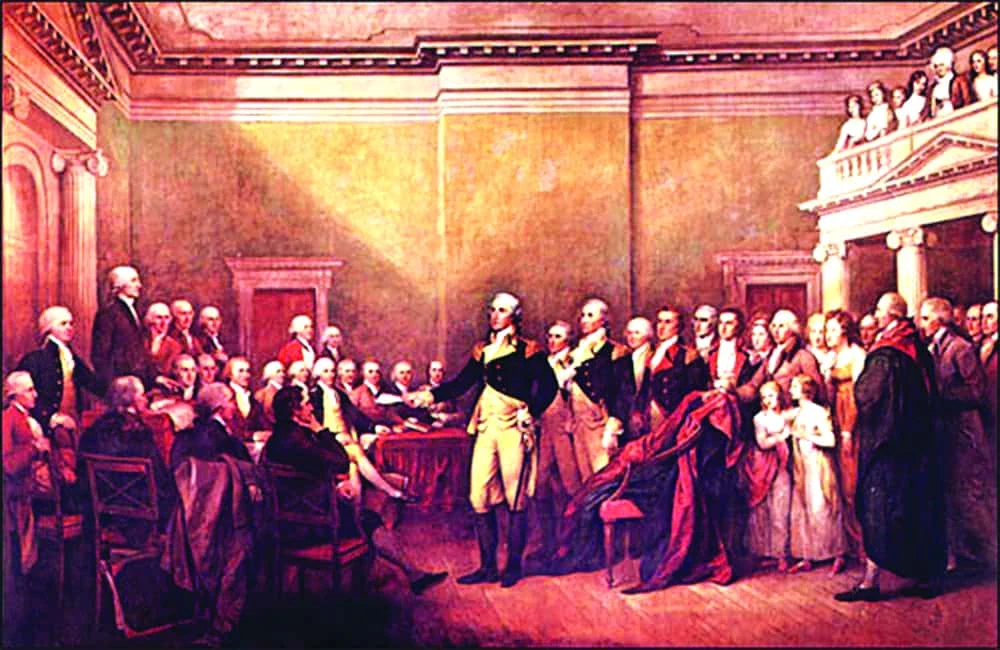
decision or one Boniface VIII induced.2 In 1783 George Washington returned his
commission while commanding a victorious army, registering no grievance — which
shows that efficacy is independent of protest and greatest where the person
forfeits the most.3 In April 1814 Napoleon, deposed by the Senate on 3 April,
signed unconditional terms on the 6th; Fontainebleau granted him Elba, an
annuity and his imperial title.4 The signature followed the removal rather than
producing it, and the settlement is recognizably a severance agreement. He
returned in 1815 and abdicated again after Waterloo, but never revoked the
first abdication and was restored by no institution.5 A resignation cannot be
withdrawn, only overthrown.
A Three-Part Taxonomy
The word is applied to at least three acts differing in initiator, audience, documentary residue and consequence. Type I, the declared resignation, is staged to be observed; its objective is witnessed departure and the transfer of cost to a second party. Type II, the undeclared resignation, is delivered to a single recipient without publicity; the motive may be identical, the method and consequences are not. Type III is not a resignation but a de facto dismissal, effected through institutional culture and characterized afterward as the leader’s own decision.

Three parties have an interest in the conflation. The institution
benefits because one undifferentiated term allows a Type III removal to be
recorded as a Type I or Type II departure: the act enters the record, the
initiator does not. The departing leader often benefits too, ambiguity being
more tolerable than either protest or defeat, and in medicine frequently a
contractual condition of the settlement. The result is a classification error
with downstream effects: protest is recorded as failure, removal as choice, and
institutional dysfunction as individual exhaustion.
Exit, Voice, and the Timing of Leverage
Hirschman’s 1970 formulation supplies the mechanism: members of a deteriorating
organization have two responses, exit and voice, with loyalty determining the
proportion.6 Resignation is the only act combining them. Exit alone transmits
no information; voice alone is deniable, the organization absorbing the
objection and retaining the objector to absorb the next. One consequence
governs every case below: leverage exists only while the act is unexercised,
evidence only once it is exercised. An officeholder who threatens to resign has
influence, one who resigns has proof, and the two are never simultaneously
available.
Type I: The Declared Resignation
On 20 October 1973 Attorney General Elliot Richardson declined an
instruction to dismiss the Watergate special prosecutor and resigned; William
Ruckelshaus declined and resigned within minutes.7 Neither delivered a
statement: the act was the statement. Cyrus Vance wrote his resignation as
Secretary of State and delivered it three days before the Iran hostage rescue
operation he had opposed, recording that he would resign irrespective of the
outcome.8 Where the act follows the outcome it cannot be distinguished from
retrospective judgment. Shevardnadze in 1990,10 Cook in 200311 and Hailemariam
Desalegn in 201812 register the same act in three different systems.
In February 2025 the acting United States Attorney for the
Southern District of New York resigned rather than dismiss the corruption
prosecution of the mayor of New York;13 six further federal prosecutors
resigned over the same directive, in what was reported as the largest mass
resignation at the Department of Justice in recent memory.14 What made the acts
Type I is that the reasoning entered the public record and third parties acted
on it. Simultaneity modifies the calculation: one departure is absorbed, seven
are not.
Four variables determine whether a Type I act functions: timing,
which decides whether it is separable from the outcome; venue, which decides
who must respond; the documentary record; and an audience with standing to act.
Where one is absent, the act remains protest to the person performing it while
functioning externally as an ordinary departure. The discriminating test is
whether cost transfers to the party being left. Howe’s did. Thatcher’s
longest-serving minister resigned on 1 November 1990 and said nothing for
twelve days; his statement of 13 November removed the assumption on which her
position depended, that no senior colleague would stand against her. She fell
four votes short in the first ballot and left office on 28 November after
eleven years.9,15 Fifteen days separated the statement from the change of
government.
Type II: The Undeclared Resignation
Type II has almost no literature because it generates almost no
evidence. The attached report is the Type II substitute for a public statement
— a record transferred to the main recipient rather than to the public.16
A hypothesis follows, offered as a hypothesis and not a finding:
Type II resigners may be disproportionately people who accepted the position to
complete a specified body of work rather than to hold the office. At least four
competing explanations predict identical behavior — temperament; structural
isolation, since a resignation is amplified only where an amplifier exists;
option preservation in a small state and a small profession; and genuine
uncertainty as to whether public protest was warranted. Discriminating among
them requires that the reason for accepting the post be established
independently, before the manner of departure is examined.
Type II terminates complicity and preserves the capacity for
subsequent work, which for a surgeon is material rather than rhetorical. Its
principal limitation is that it is externally indistinguishable from
acquiescence, and institutions depend on that: silence intended as restraint is
received outside as consent. It generates little or no entry in the record,
which is why the category remains unquantified.
Type III: Removal Presented as Resignation
Institutions maintain a stable lexicon for the third category:
stepping down to pursue other opportunities; returning to the faculty;
attending to elderly parents; concentrating on research and patient care. Each
formulation obscures a specific antecedent, and each is accepted at face value
by the literature that then classifies the departure as voluntary.
Corporate governance addressed the equivalent problem thirty years
ago. Parrino’s 1997 classification treats the official announcement as a
hypothesis rather than a conclusion: a departure is reclassified as forced
where the surrounding record indicates removal or unspecified policy
differences.17 The analogy is close — a dean occupies the position of a board,
faculty that of shareholders — but the verification apparatus does not
transfer: academic medicine generates no filings carrying a penalty for a
materially misleading account.
The available data are descriptive and silent as to cause. Mean
tenure of internal medicine chairs at United States medical schools fell from
approximately 5.3 years in the 1970s to approximately 4.0 in 2000–2006, while
mean interim chair tenure rose from about 1.4 to 2.4 years.18 Annual chair
turnover in United States obstetrics and gynecology departments approximately
doubled between 1981 and 2005, from 6.0% to 12.7%.19 Among 178 United States
surgery department chairs, women held the position a median of 5.3 years
against 7.0 for men.20 Among 1,166 medical school deans appointed between 1959
and 2019, median tenure was 4.3 years.21 Each series enumerates departures;
none classifies them. The field knows how often its leaders leave and has no
estimate of how often they were removed.
Burnout completes the reclassification. Shanafelt and Noseworthy
established that burnout is a system-level problem institutions persistently
treat as an individual one.22 Read in reverse, the finding specifies a
mechanism: an organization that withholds resources, reverses decisions after
they are taken and excludes a leader from the forums where decisions are made
will reliably produce exhaustion, which is then advanced as the cause of the
departure. The diagnosis is correct and the causal direction inverted.
The record is then closed. In the United Kingdom, 98 higher
education institutions reported issuing close to 11,000 non-disclosure
agreements between 2014–15 and 2018–19.23 At one large United States university,
student journalists documented ten settlement agreements with departing
employees over six months, carrying non-disparagement provisions and payments
exceeding $1.26 million, none appearing in public documents.24 The instrument
that resolves the dispute eliminates the evidence.
Four consequences follow. For the individual, selecting the wrong
type expends the act without effect. For the institution, a forced departure
recorded as voluntary forecloses learning: the successor inherits the same
withheld resources and parallel structures, and the sequence recurs under a
different name. For the evidence base, a discipline that would not accept
self-reported outcomes in a surgical trial accepts them without qualification in
its own leadership data. And for patient safety, the leader most exposed to
quiet removal is the one pressing hardest on staffing, safety or resources.
Four limitations bound these conclusions. The historical cases
come from the published record, which over-represents Type I by construction;
the essay reasons from visible cases to invisible ones, and that inference is
not secured by the evidence presented. The account of my own resignation is a
self-report by an interested party, offered as illustration and not as
evidence. No denominator exists: the frequency of Type III in academic medicine
is unknown. And the Parrino method is proposed for transfer here, not
demonstrated.
An Evaluative Framework
Dobel argued that the moral case for resignation rests on three
dimensions of integrity — the promise made in accepting office, the competence
to perform it, and the capacity to be effective in it — failure in any one
generating strong moral reasons to resign.25 Six operational questions follow.
What was the appointment intended to accomplish, and does that remain
achievable? Is the obstacle a disagreement, which has identifiable
counterparties, or a design, which exhibits a pattern of resources withheld and
exclusion from the forums where decisions occur? Would a Type I act alter
anything, which requires both an audience with standing and a cost that
transfers? What capacity will remain the following day? What is being signed,
and under what time constraint? And what will the departure demonstrate to
those who remain?
Conclusion
The resignation letter cannot classify itself. Classification
requires external evidence — the conditions surrounding the letter rather than
its contents — and that work has not been undertaken systematically in medicine
or in government. The power of resignation does not reside in the departure but
in its availability: a leader who cannot conceive of resigning has forfeited
the only leverage that does not depend on another party’s permission. The
option need not be exercised to function; it is required only that it be real.
An institution that can engineer a departure and reclassify it has established,
for every leader remaining, that the option is not real — that the departure,
when it comes, will be characterised by another party, in language chosen by
that party.
Key Points
• Three acts share the
term resignation and are separable by initiator, intended audience, documentary
residue and who expends the leverage.
• Leverage exists only
while the act is unexercised and evidence only once it is exercised; the two
are never simultaneously available.
• Type I efficacy depends
on four concurrent variables: timing, venue, documentary record, and an
audience with standing to respond.
• Type II is externally
indistinguishable from acquiescence, which is why the category remains
unquantified.
• Burnout and the
non-disparagement settlement convert Type III into Type II in the record and
eliminate the confirmatory evidence.
References
1. Abdication. Encyclopaedia Britannica. Available at:
britannica.com/topic/abdication
2. Papal resignations: the case of Celestine V. Lillian Goldman
Law Library, Yale Law School. Available at: library.law.yale.edu (Abdication of
Pietro da Morrone, Pope Celestine V, 13 December 1294; the enabling
constitution and the disputed circumstances.)
3. Resignation of military commission [George Washington,
Annapolis, 23 December 1783]. Digital Encyclopedia, George Washington’s Mount
Vernon. Available at: mountvernon.org (Includes George III’s reported remark to
Benjamin West.)
4. 4, 6, and 11 April 1814: Napoleon I’s three abdication
declarations. Napoleonica. La Revue, 2023. Available at: shs.cairn.info (The
conditional abdication of 4 April, the unconditional act of 6 April, and the
Treaty of Fontainebleau of 11 April 1814.)
5. The Hundred Days. World History Encyclopedia. Available at:
worldhistory.org (Departure from Elba, February 1815; Waterloo, 18 June 1815;
second abdication, 22 June 1815; exile to Saint Helena.)
6. Hirschman AO. Exit, Voice, and Loyalty: Responses to Decline in
Firms, Organizations, and States. Cambridge, MA: Harvard University Press;
1970.
7. October 20, 1973: The Saturday Night Massacre. ABA Journal.
Available at: abajournal.com
8. Editorial Note [Vance resignation letter, 21 April 1980].
Foreign Relations of the United States, 1977–1980, Volume II, Document 199.
Office of the Historian, US Department of State. Available at:
history.state.gov
9. Howe G. Personal Statement [resignation from the Cabinet, 1
November 1990]. Parliamentary Debates (Hansard), House of Commons, 6th series,
13 November 1990, vol 180, cols 461–465. Available at: api.parliament.uk
10. Shevardnadze E. Speech to the Fourth Congress of People’s
Deputies, 20 December 1990. Seventeen Moments in Soviet History, Michigan State
University. Available at: soviethistory.msu.edu
11. Cook R. The Point of Departure. London: Simon & Schuster;
2003. (Resignation from the Cabinet and speech to the House of Commons, 17
March 2003.)
12. Ethiopia prime minister Hailemariam Desalegn resigns. Al
Jazeera, 15 February 2018. Available at: aljazeera.com
13. Acting US attorney in Manhattan resigns after directive to
drop case against Mayor Eric Adams. ABC7 New York (WABC), 13 February 2025.
Available at: abc7ny.com
14. Fallout from the Eric Adams case continues at the Justice
Department. NPR, 14 February 2025. Available at: npr.org (Seven federal
prosecutors in New York and Washington resigned; reported as the largest mass
resignation at the Department in recent memory.)
15. MT’s private files for 1990 — (7) uneasy peace then leadership
election. Margaret Thatcher Foundation archive. Available at:
margaretthatcher.org (Howe’s resignation and speech; Heseltine’s challenge; the
first ballot of 20 November 1990 and Thatcher’s withdrawal on 22 November.)
16. Latifi R. A Conversation with Dr. Rifat Latifi [self-interview
on leaving the Ministry of Health of Kosova]. Dielli — The Sun, 2025. Available
at: gazetadielli.com
17. Parrino R. CEO turnover and outside succession: a
cross-sectional analysis. Journal of Financial Economics. 1997;46(2):165–197.
18. Ringenbach JL, Ibrahim T. Tenures for department chairs: how
short is too short? The American Journal of Medicine. 2008;121(2):163–168.
Available at: amjmed.com
19. Rayburn WF, Schrader RM, Cain JM, Artal R, Anderson GD,
Merkatz IR. Tenure of academic chairs in obstetrics and gynecology: a 25-year
perspective. Obstetrics & Gynecology. 2006;108(5):1217–1221.
doi:10.1097/01.AOG.0000240140.27246.93. PMID: 17077245.
20. Kennedy GE, Bergstresser SL, Rakestraw SL, Novak Z, Corey B,
Chen H, Sutzko DC. Does chair of surgery gender influence divisional or
residency program director gender diversity? Journal of Surgical Research.
2021;267:224–228. doi:10.1016/j.jss.2021.05.026. PMID: 34157491.
21. Chatterjee A, Chin LS, Connolly H, et al. Length of tenure of
U.S. medical school deans who started in their position from academic years
1959–1960 to 2018–2019. Academic Medicine. 2025;100(9):1044–1050.
doi:10.1097/ACM.0000000000006028. PMID: 40080627.
22. Shanafelt TD, Noseworthy JH. Executive leadership and
physician well-being: nine organizational strategies to promote engagement and
reduce burnout. Mayo Clinic Proceedings. 2017;92(1):129–146.
doi:10.1016/j.mayocp.2016.10.004.
23. Stokel-Walker C. UK universities issue 11K non-disclosure
agreements in five years. Times Higher Education, 11 April 2019. Available at:
timeshighereducation.com
24. Buying Silence: settlement agreements between the University
of Michigan and former employees, November 2018 – April 2019. The Michigan
Daily, 10 December 2019. Available at: digital.bentley.umich.edu
25. Dobel JP. The ethics of resigning. Journal of Policy Analysis
and Management. 1999;18(2):245–263. doi:10.1002/(SICI)1520-6688(199921)18:2<245::AID-PAM3>3.0.CO;2-H.
আরও পড়ুন -