WAR, FAMINE AND TURBULENCE: GLOBAL TRENDS 2023
📝
🕐 2023-05-13 13:35:22



Air Vice Marshal MAHMUD HUSSAIN (Retd)
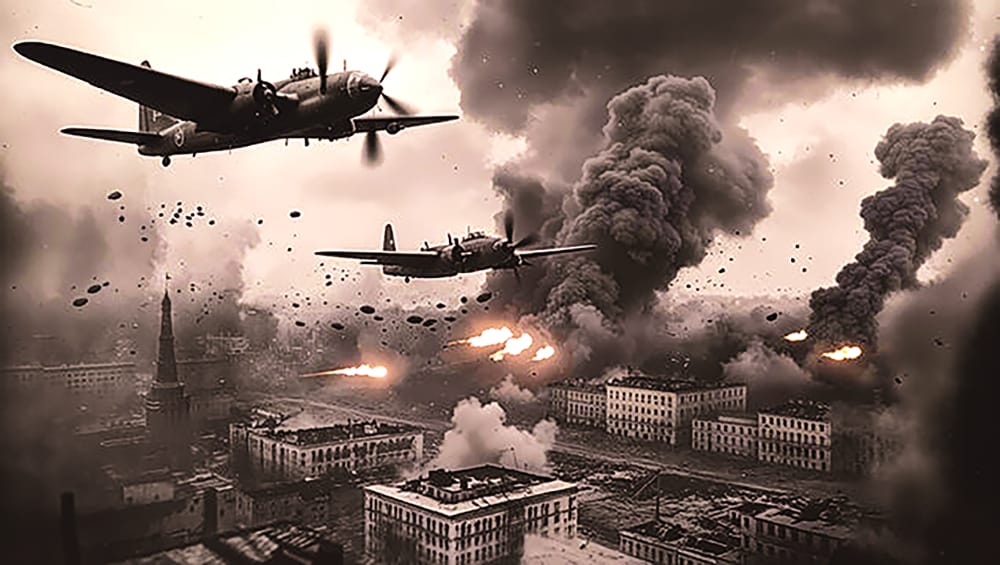
The year 2023 begins with an ongoing war. This spells ominous impression for a new year. Intelligence reports say that Russia is planning a fresh offensive against Ukraine to recover its conquered territories which she again lost to Ukrainian forces. One cannot predict that the Russia-Ukraine War will come to an end in 2023. This portrays a gloomy picture of the world already hammered by the pandemic and post-pandemic turbulence.
In the freezing winter Russia could launch a big attack from Donbas in the east, or even from Belarus, a puppet state in the north. Putin may even think of making a second attempt to take the capital, Kyiv. Whatever it is, the consequences of such attempts will be gruesome and tragic for the world. If we go by the words of Carl Von Clausewitz, the great philosopher of War that “War is an organized violence”, then the Ukrainians have shown that they are better than Putin’s Russian forces in conducting violence in the battlefields. Putin has understood that Ukraine is not alone in its crusade against Russia. The US and Europe have stood by her side by providing military, economic and moral support. This is a big challenge to Russia’s hubris fed by Putin’s revanchist idea that the Old Russian Empire can be recreated once again. If that Russian dream fails, the year 2023 will be an ominous period in the history of the world. I have my own logic.
Ukraine made a great sacrifice in 1994, when it surrendered the Soviet nuclear weapons on its soil. Her sacrifice has proved worthless 20 years later. On the other hand, Putin’s nuclear threats are a proof that Ukraine has marked a superlative edge over Russia in hybrid warfare. If Ukraine is adequately supported, it can recover more territory. Ukraine has used HIMARS, a rocket system the Americans have been supplying since June, to devastating effect against Russian ammunition stores, and command and control system, allowing her forces rapid advance in the north-east and the south. If Putin’s humiliation reaches the point of no return, he might retaliate with the choice of tactical nuclear weapons. When it comes to the destructive image of tactical or strategic nuclear weapons, there is no difference. Both are horrendous in terms of human casualties, and in destroying the productive capacity of the soil.
That said, what will be the fate of geo-politics in 2023. The benefits of the war to the West is already clear. Russia has been enormously weakened as a great power, making Europe’s flanks much easier to defend. For Ukraine, which has suffered horrific losses, the outcome looks much less certain in 2023.
Europe has always been the soil of turbulence since the last century. Two World Wars were started and fought at its behest. Europe’s thirst for wealth has been as voracious as its appetite for war. As a result, its moral strength has depleted so much beyond repair. It could never come out of the psychosis of perpetual fear to its mental make-up. That is why it is so much dominated by the imagination of an irredeemable narcissism which is largely its own creation. It has also lost its own voice of defense. NATO is a good example whose symbol of unity is located beyond its own geostrategic exceptionality. The constant manoeuver to create a balance of power by playing out the great powers of Europe has only resulted in its weakening of political power. Germany which was once an emblem of greatness and behemoth is now dwindling on the brink of despair as a state. Constant testing of its indomitable resilience has only come at a great cost.
Due to Russia-Ukraine War, energy crisis will likely put the world into disarray. A simulation exercise played by The Economist Magazine reveals that if Russia faces catastrophic losses on the battlefield, it will, no longer, care about money or even its allies in Europe, say Turkey and Hungary. It will opt for all-out energy war. It has already shut its main gas supply route to Europe, but Europe needs all it can get, so cutting the rest will wreak havoc. In that case, Europe’s storage will be emptied by November 2023, and remain bare for the whole of 2024. The more Russian fuel cannot get to the market, the more Europe has to pay to other oil-surplus countries to replace it. It will only hike the oil prices in the global market, and become an excruciating economic pain for the developing world.
In early October, Bangladesh suffered from a grid failure that triggered a black out across 75-80 percent of the country. Till November 2022, looming power crisis, where long power cuts and load shedding were common was the result of an exponential increase in oil and gas prices owing to Russia’s energy war, OPEC’s oil supply cuts and the European Union embargo on Russian crude oil. Being an oil-importing country, Bangladesh is already feeling the pressure through high import payments. With high oil prices, the chain effect is felt through a hike in the prices of gas, fertilizer, and other essentials including transportation and food. 2023 will continue to threaten Bangladesh’s energy security.
War is also traumatizing a fragile world towards famine. With the invasion of Ukraine, the War has destroyed the lives of people far from the battlefield on a scale that even the war mongers will regret. It is destroying a global food system already battered by COVID-19, climate change and energy shock. At the beginning of 2022, the number of people, with access to food was so poor that their lives or livelihoods were at immediate risk, and had risen from 108m to 193m over the past five years, according to the UN’s World Food Programme. In 2021, Russia and Ukraine were the world’s first and fifth biggest exporters of wheat, shipping 28 percent of the world market. According to the United Nations, nearly 50 countries depend on either Russia or Ukraine, or both, for more than 30 percent of their wheat imports; for 26 of them the figure is over 50 percent. Increase in food price means decrease in real income. If that happens, vulnerable people will be affected by hunger due to inability to pay for higher prices, and with it will be described disproportionate social, political and human damage.

Photo: Net
World Bank survey states that about 30 percent people in Bangladesh are facing food scarcity, though the country made a recovery from the pandemic induced shocks. Prime Minister Sheikh Hasina as recent as October 2022 reiterated her call to work together in growing more food bringing every inch of lands under cultivation to protect Bangladesh from the possible global famine or food crisis against the backdrop of the Russia-Ukraine war. We should do well by once again reading the effects of the war-induced famines of Bengal in 1943 and 1770. Food insecurity will be one of the great challenges for Bangladesh in 2023.
War coupled with food and energy insecurity, how the World Order will be like in 2023. It is difficult to predict exactly, but some thoughts can be put in place to see things in their clear perspective. It is clear that 2023 will not be a West-dominated US-led World Order. Russia-Ukraine War has broken the confidence in the West-led norms and institutions. Russia’s dalliance with China may turn out to be globalization going into reverse. China has a talent for finding partners who are also in search of an alternative to the status quo. Therefore, in 2023, China-US rivalry will clearly dominate geo-politics because it incites China to accept universal values as a tool of American power. Even to Chinese who once saw the unipolar era dominated by America after the Cold War as “benign hegemony” are now disillusioned.
Now the question arises has the United States fared well as a global leader who is capable of organizing world order in a manner that the rest of the world is driven to its organizing principles. The answer surely is in the negative. The idea of ruling the world is morally different than guiding it toward a collective vision. If the US wants to gain back its popular support, it must also ardently espouse its treasury of soft power, something which it so intelligently popularized in the past as a tool of its geo-political aspiration.
So, in 2023, global leadership will matter to steer the world clear of its ensuing turbulence. Which great powers will produce such leaders to restore peace is the question. Europe is the continent which will be in the thick of war-induced turbulence. Can it invoke leaders of the like of Matternich, Castlereagh and Talleyrand, who after the Napoleonic Wars, shaped the politics of Europe for a stable political order? The answer is uncertain. But the Western leaders can, no longer, avoid President Xi, and must not go down the path of confrontation with China as they have with Russia. That will be the test for the hypothesis of the wisdom of their leadership. After World War II, when Konrad Adenaeur and Charles de Gaulle sat together and saw through their tragedies a duty to rebuild Europe in the design of peace and harmony, they demonstrated that they were great visionaries who could overcome their national enmity, and supplant it with a higher goal of achieving a resolute Europe. They were the revivalists of the Concert of Europe long envisioned more than a century and half ago. Can Europe beget such personalities in future again? Europe is in the center of the world. A slight turbulence on its wings flutters through the space across the world, and is felt strongly in Asia. That is what is called “Butterfly Effect” in Physics.
Everyone says that the future is in Asia. But then what kind of future we are talking about. The year 2023 predicts only a grim picture. It is not only the Russia-Ukraine War but also the manner in which the attention is paid to its geo-strategic concerns draws our concerns. China and India are the two adversaries who have so far shown no sign of relief to their acrimonious temperament. This augurs ill for the rest of the continent. This has given encouragement to great powers from other continents to exercise unobtrusive freedom of thought about the Indo-Pacific region. This obviously downplays Asia’s ability to checkmate adversarial intentions of non-Asian powers. The result is one that is not palatable to the reckoning of small states of the region.
For Bangladesh, 2023 will be a remarkable year for many reasons. Most important of them all will be how the political parties avoid the path of conflict and make ways for reconciliation for the greater national good. We must also remember that Democracy does not inhere in economic development only. Economic development is one of the elements of political goals. Had economic excellence been the only institution for enduring democracy than many authoritarian regimes would be the best model for emulation. But it is not the case, at least in terms of human aspiration. People want more than simply the speech-delivery of words.

Therefore, political goal for 2023 in Bangladesh should aim at institutional development. Given the conflictual nature of our domestic politics, the elections in January 2024 foretells a period of turbulence in 2023. It is up to our political leadership to demonstrate that they have the potential and wisdom to rise above parochialism, and steer us away from the turbulence bestriding the year of 2023.
Great hopes are born under great crises. Pandemic and Russia-Ukraine War are the two phenomena that have recently pitted mankind face to face through turbulent years. How the world and the individual nations will fare, will depend on the will of the people. But most will be needed the commitment of great powers in realizing that a negative cycle in political history cannot be allowed to last longer. States are abstract realities. It is their leaders who make and transform histories. In that great act of creation, the wisdom, sagacity and panache of leaders come out as the supreme test of character dedicated to steering the events through a course that drifts away from turbulence and moves towards stability. In the year 2023, it will be time for the leaders of the US, Europe, Russia, China and India to sit down for a conscientious reckoning whether it is appropriate at this critical juncture of history to fiddle with power politik and put the world in peril at the cost of other nations.
Air Vice Marshal Mahmud Hussain is a retired air force officer. He served as High Commissioner of Bangladesh to Brunei Darussalam from November 2016 to September 2020. He served as the Chairman, Civil Aviation Authority of Bangladesh (CAAB). Presently, he is working as the Distinguished Expert at Bangabandhu Sheikh Mujibur Rahman Aviation and Aerospace University (BSMRAAU).





More News From This Category