




Editor & Publisher: Rabb Majumder
House # 05 (2nd Floor, 2-C), Road# 04, Banani DOHS, Dhaka - 1206
Phone: +8801715822782
Phone (Advertisement): +8801712863234
Email: rabb.h.majumder@gmail.com, info@securityworldbd.com

EVENT REPORT
Interfaith Harmony in Focus at Dhaka Reception for Holy See National Day and Papal Election
Rabb Majumder
08:25, 9 May, 2026
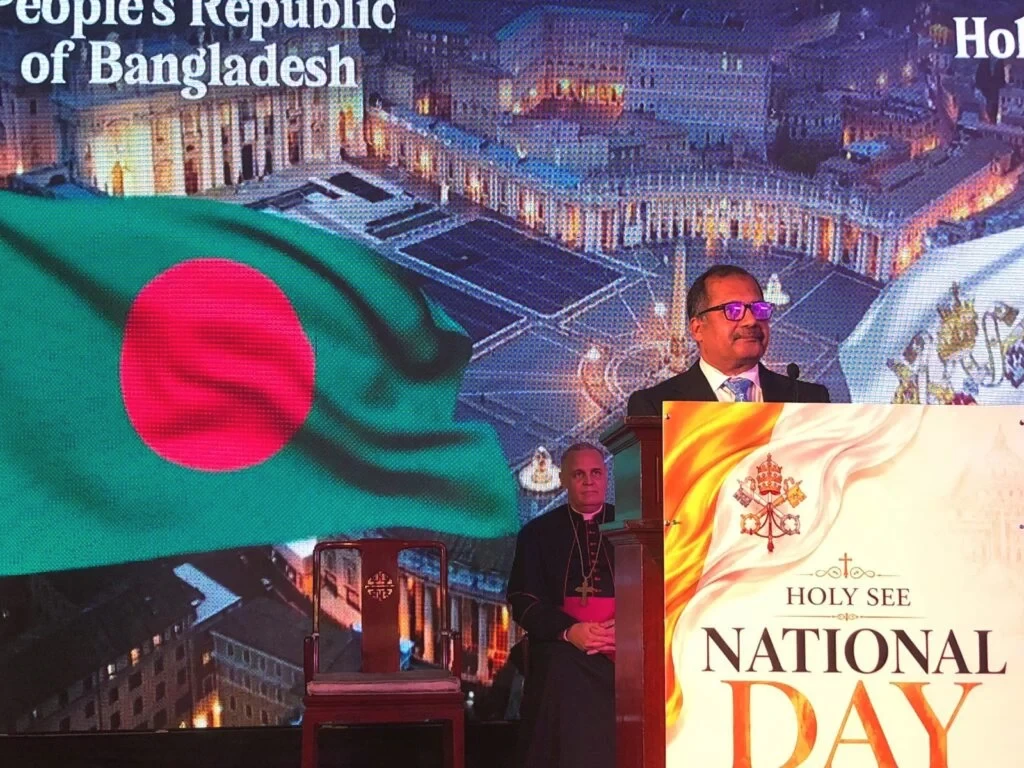
A high-profile diplomatic reception in the capital celebrated the National Day of the Holy See–Vatican Embassy and the election of Pope Leo XIV to the pontificate. The event, organized by Archbishop Kevin S. Randall, Vatican Ambassador and Apostolic Nuncio to Bangladesh, brought together a diverse mix of international figures, government officials, business leaders, and religious and civic leaders, underscoring the durable ties between Bangladesh and the Holy See.
A global stage, a shared mission
The guest list read like a who’s who of diplomacy and civil society: Information and Broadcasting Minister Zahir Uddin Swapan served as the chief guest, flanked by ambassadors and diplomats from multiple countries, senior government officials, and prominent businesspeople. The attendance of dignitaries from various nations highlighted the papal election’s resonance beyond ecclesiastical circles, signaling a shared interest in moral leadership, humanitarian service, and peace in a rapidly evolving global landscape.
In a tone that mixed ceremonial gravity with pragmatic optimism, the minister described the papal election as more than a religious milestone. “It is a global beacon of moral leadership and a renewed commitment to peace, humanitarian service, and human dignity,” he said. He noted that the Holy See’s moral leadership has historically influenced international discourse on peace, justice, and human rights, a role that Bangladesh recognizes as compatible with its own development priorities.
A bilateral moral compass: Bangladesh–Holy See relations
“The relationship between Bangladesh and the Holy See is founded on the shared values of peace, mutual respect, and human compassion,” the minister stated. “This partnership advances our common goals of religious harmony, interfaith dialogue, and human welfare.” The remarks underscored Bangladesh’s long-standing commitment to pluralism and religious tolerance, principles that have helped shape the country’s social policy and development programs.
Contributions of Catholic institutions in Bangladesh
The minister also highlighted the important role played by Catholic educational institutions, hospitals, and social organizations in Bangladesh. He praised these institutions for serving remote and underprivileged communities, noting that their work complements government initiatives in health, education, and social welfare. This acknowledgment reflects recognition at the highest levels of the state of the civil society sector’s contribution to national well-being.
Interfaith dialogue and fraternity: a path forward
Recalling a recent, week-long conference on interfaith tolerance and fraternity organized by the Apostolic Mission in Dhaka last September, the minister expressed optimism that such initiatives can strengthen constructive dialogue and social justice across religious communities. The event’s timing—on the heels of the Vatican’s election—was presented as a moment to reaffirm commitment to coexistence and shared human values.

Policy direction: Bangladesh First and religious freedom
The Information Minister touched on the broader policy landscape, stating that the current government, led by Prime Minister Tarique Rahman, is committed to building an inclusive, humane, and harmonious society aligned with the Bangladesh First philosophy. He reiterated support for the principle that religion belongs to the individual and not the state, emphasizing the right of every citizen to practice their faith freely while respecting others. This stance was framed as essential to maintaining social stability and fostering economic growth in a plural society.
A message of shared humanity
Beyond ceremonial formalities, the reception was portrayed as a symbolic gathering that reflects a broader regional and global trend: leaders from diverse backgrounds articulating a shared commitment to interfaith understanding, humanitarian outreach, and moral leadership. Speakers and attendees underscored that such dialogues and collaborations are critical in navigating global challenges—from conflict resolution to climate resilience and sustainable development.
Looking ahead: continuity and cooperation
The event concluded with a consensus that interfaith dialogue and religious tolerance will continue to play a central role in bilateral and multilateral relations. As Bangladesh forges ahead on its development path, the engagement with the Holy See is framed as a conduit for advancing peace, education, health, and humanitarian initiatives.
Editorial notes for editors
This piece places the event within the broader context of Bangladesh–Holy See relations and the global significance of papal leadership.
আরও পড়ুন -